A Community of Philosophers
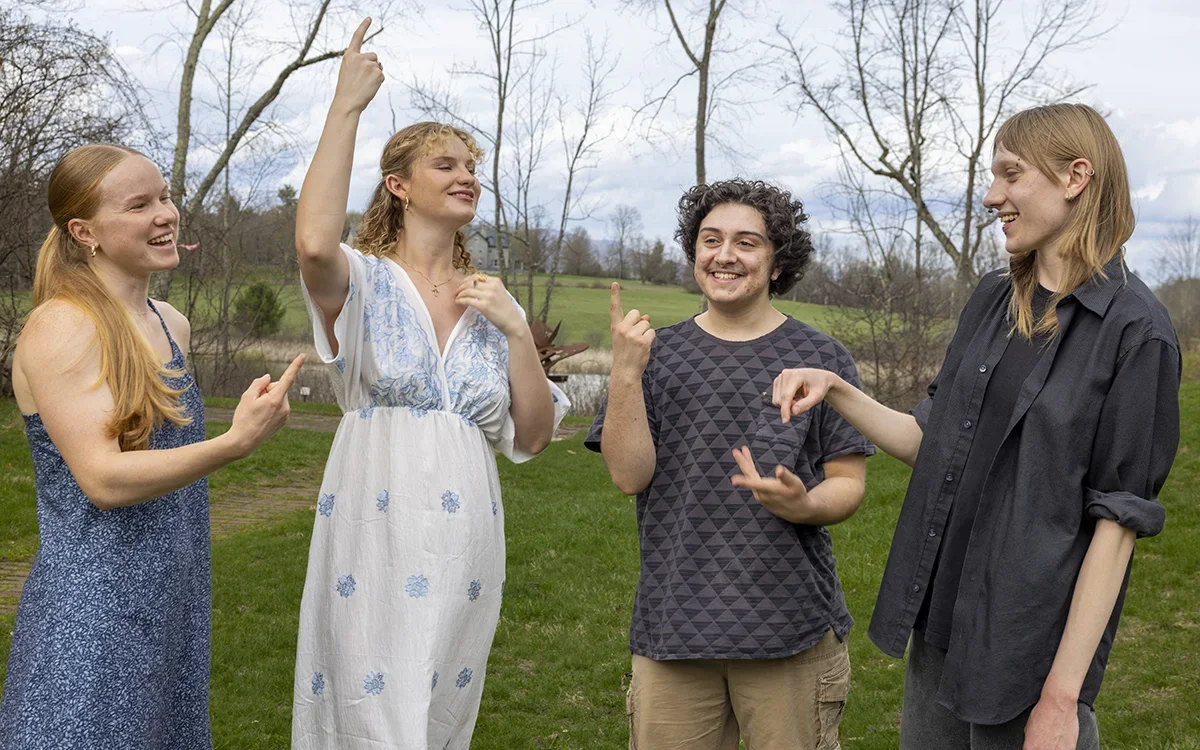
Bennington students present at conferences across the northeast.
Bennington College students Bianca Burz ’26, Hailey McDowell ’27, Lil Gael Montevecchi ’26, and Owen Musser ’27 submitted papers and were invited to present at three philosophy conferences this spring.
“This is remarkable,” said faculty member in Philosophy Catherine McKeen. “This level of conference activity would be unusual even at a much larger school.”
Musser and Montevecchi joined about six or seven student presenters from mostly northeast colleges and universities at the University of Massachusetts, Boston, 3rd Annual Undergraduate Philosophy Conference in March.
Montevecchi and McDowell were among the 23 student presenters at the 30th Annual SUNY Oneonta Undergraduate Philosophy Conference in April. It is the longest running undergraduate conference and one of the largest.
“There were people there from really far away, like the University of Hawaii, and there were not as many people from small liberal arts colleges,” said McDowell, whose paper on the metaphysics of time was an argument in favor of a tweaked version of eternalism, as opposed to straight eternalism or presentism. “It was intimidating. They were all so well read.”
McDowell also presented at the 14th Annual Hudson Valley Undergraduate Philosophy Conference at Marist University in April, where there were just eight presenters, half of whom were Marist students, McDowell estimated.
“[Other students at conferences] are going through an educational process that is very different from what we are going through. They have a philosophy major. They took Epistemology 101. They took formal logic,” said McDowell. “They have these things that every single one of them took, and we maybe have taken [these subjects] or maybe we haven’t because we don’t have a major here. [Whether that’s an advantage or a disadvantage], I think it depends on the type of student you are.”
The Bennington students also noted a difference in demeanor between themselves and other students at the conferences. The Bennington students were already thinking of themselves as philosophers, while the students from other colleges seemed to think of the study of philosophy as frivolous or in need of a justification.
“They say, ‘I am studying philosophy so I can do business ethics or be a lawyer or develop AI software,’” said Montevecchi, whose paper contests an example Philosopher Kate Abramson put forward in her 2014 essay and 2024 book On Gaslighting. “That’s not the case here at all. Here, people are interested in studying philosophy because they find it satisfying and interesting.”
“It feels good to represent the alternative type of education that works really well for me and obviously has worked well for others,” Montevecchi continued. “We have papers that are of the same quality and maybe a little more philosophically creative because we have been allowed to do more. I am glad we are able to present Bennington as a community.”
One reason that McKeen notes for the conference success is the energy coming out of the student-run Philosophy Club, which has been very active over the past 3 years, said McKeen. The students agree.
“We all want to have a philosophical community. We like having friends in philosophy. It’s not a competitive thing,” said McDowell. “We do philosophy extracurricularly. We spend our free time revising papers.”
The club meets on Friday nights to discuss a reading or screen a movie. Musser is the organizer.
“For me, Philosophy Club has been a really important part of my development as a philosopher and has helped me see myself as someone interested in philosophy, someone who doesn’t just take philosophy classes but a person who explores the subject on my own,” said Musser, whose conference paper drew from Philosopher Karen Jones’ ideas on the politics of credibility and astonishing reports to argue that we should trust teens when they say they are trans. “Even before I ran [the club], when older students ran it, it really introduced me to core ideas in the discipline.”
Through the club, they organized a visit to the Greater Philadelphia Philosophy Conference at Temple University last year, which gave them their first look at what philosophy conferences are like. They also read and edit each other’s papers. They share contacts for undergraduate philosophy conferences. Sometimes they present ideas in their earliest stages to the group to see how they hold up.
“I presented my idea for my paper in very early stages at Philosophy Club,” said Montevecchi. “That was just good practice. How do you explain everything you’ve thought about to other people? As I was presenting, I was thinking about how I have this idea and about how I can present it in a way people will understand.”
The students also credit their faculty members for their success. McKeen encouraged students who had submitted strong papers for class assignments to submit those same papers to conferences.
“Her direct encouragement [was really important]. I would not have [submitted] it if that had not happened,” said Musser.
McKeen also shared institutional resources, the SCT Conference Grant, which reimburses students for conference travel and housing. Meanwhile, faculty member in Philosophy Paul Voice shared advice about how to present, how to write an abstract, and how to edit papers to the right length.
“They imbued us with the skills necessary to do this on our own,” said Musser.
If there is a third ingredient in the recipe for success presenting at undergraduate philosophy conferences, it is Field Work Term (FWT), which happens to line up exactly with many spring conference deadlines. All of the students whose papers were accepted used part of their FWT to send out papers.
“All of the thoughts from last term were sitting in my head. And I thought, ‘let me go back, polish this thing up, and get it out there.’ It is the perfect time to do that,” said Musser. “If I had been in classes, it never would have happened. I definitely feel that is part of why we were so successful.”
Apart from writing their theses in Philosophy, McDowell, Montevecchi, and Musser have another project in mind for their senior year. Their next project is to make a philosophy conference of their own.
“After we went to the SUNY Oneonta conference, we were thinking about organizing one here,” said McDowell. “I am pretty committed to making it happen.”
They talked to the people who organized the conferences they attended, and they made a plan. They intend to send out a call for papers in the fall and use a tutorial to read the submissions.
“It’s not surprising to me that Bennington creates a bunch of people who see themselves as philosophers, who participate in this community, and create work that is valuable and interesting,” said Musser. “Bennington attracts people who are self directed and motivated. Once we are all interested in something, of course we are going to go out into the world and do it as well as we can. That’s exactly what Bennington prepares you to do successfully.”