Eugene Onegin: A Bluegrass Musical and an Artist’s Coming of Age
An interview with composer and writer Sarah Gancher ’01 conducted and transcribed by Erin Mann ’28 and Lara Pascoe.
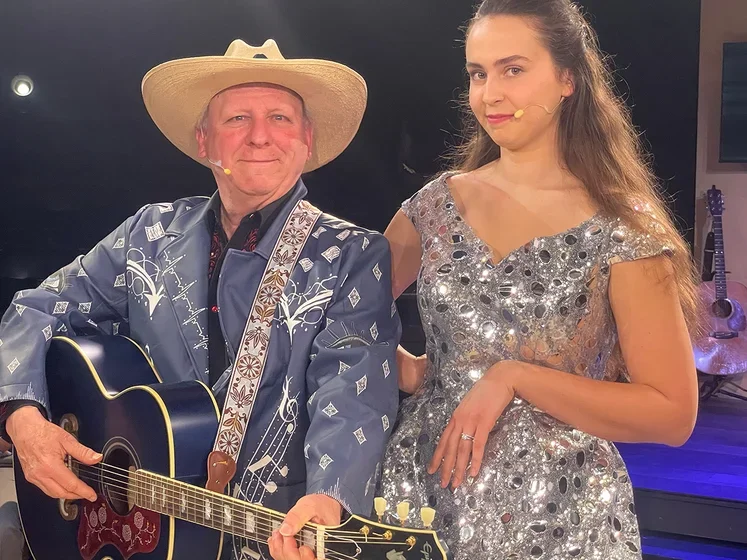
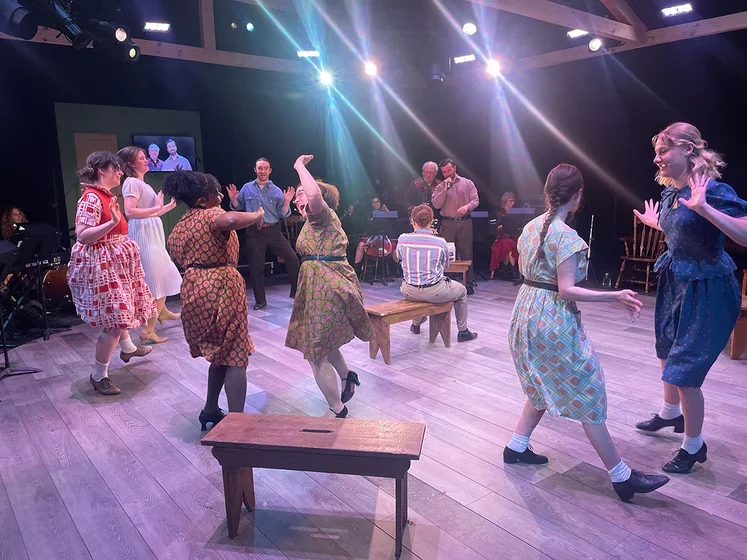
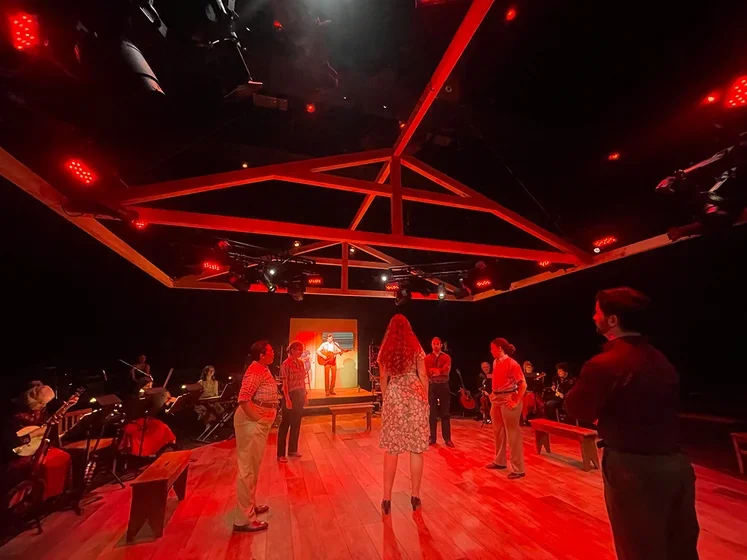
Eugene Onegin, written by Bennington alum Sarah Gancher ’01, premiered at the Lester Martin Theater in April 2026. The production featured a student-faculty cast and creative team, including Jean Randich (Director), John Kirk (Music Director) Kerry Ryer-Parke (Choral Director) and Trish Miller (Country Dance Choreography). Inspired by Pushkin’s novel of the same name and Tchaikovsky’s opera, Gancher composed original bluegrass music to weave a story of love, ambition, heartbreak, and coming of age.
As Gancher introduces in the show’s prologue, the musical may be named after Eugene, but this is a story about Tanya. Tanya is a young woman in 1949 Arkansas who has a deep love for her family and music. The show follows her journey as an artist after a series of devastating events leads her to Nashville, and away from the charming and destructive Eugene. Gancher explores the difficult decisions women have to make to survive, and more importantly, to make their life their own. Life can be hard; we lose the people we love, marry the wrong people, fight for causes even though it threatens our own security. When the dust settles, however, we still have ourselves, and we still have music.
We had a chance to sit down with Gancher ahead of the show’s Arkansas premiere at TheatreSquared in June 2026. An accredited playwright and composer, Gancher wrote the show’s book, lyrics, and music and spoke to us about her creative process as an artist.
How is it being back at Bennington and having one of your works be performed by the students here?
It’s crazy! It's funny because this moment is such a good encapsulation of it; I'm here at Bennington and I'm looking out the window at places that I know well, but this is a view that didn't exist when I was here. I'm in a room that didn’t exist when I was here, and talking to people that didn’t exist when I was here! So it's kind of trippy in that way, but you know VAPA hasn’t changed, and obviously I spent so much time there— it was a formative place for me.
I remember being in Jean’s [Randich] productions as a young theatre student, and I did a show in Margot Tenney, and I did a show in Newman Court: in all these places, my teenage self is here, too. When you write, one of your sources that you draw from is yourself. I'm writing about these teenage girls, Tanya and Olga, and a lot of what I'm drawing on is experiences that I lived here. That’s also not something I had thought about until last night, and then I was like, “this is wild. It’s pretty crazy to be making this thing about having a crush on a boy in a place where I literally had a crush on a boy.”
Were your sisters also trying to warn you?
Yeah! So that part of it is sweet, and Jean’s an important person in my life, so it means a lot to me that she wanted to do this. It's slightly wild because we’re still working on [Eugene Onegin] pretty intensely. The normal order of things is that you would work on it, you put it out, you figure it out, you lock the script, and then you go “Okay, now you can [produce] it,” but this is pretty out of order. But it's also cool and informative; we’re learning a lot, the students are doing great work, and it's cool to see. Just beautiful, really.
Was there anything new that you realised from creating the script, reading the script, and then seeing it staged?
Well, the thing that is true no matter what is that you always learn completely new stuff when you see something with an audience and up on its feet – even if the production is totally different than you would personally envision it.
There are certain aspects that you can only see in the presence of a bunch of other people, so I always feel like when I’m writing alone by myself, I'm writing by candlelight. I can only see a little bit. Then, if I do it with a reader or my writing group, I’ve got one of those camping flashlights that can be a lantern. And if I do it at a staged reading, you see a bit more, and when you get into previews, it’s like, “Okay now, we’re outside, and it is the middle of summer, and I can see everything.” There’s all kinds of shit that you understand in a totally different way.
It’s one thing to write a play, but to also write the music...what was that like? Did you have any hurdles and how did you overcome them?
I had a lot of hurdles.
When I was at Bennington, my Plan was in Directing, Playwriting, and Jazz Performance. At the time, I talked about it as a major in improvisations. I was interested in free jazz, and I was interested in Grotowski and Ragtime, and I was interested in Comedia dell’arte, clowning and the traditional French clowning… just a wide variety of things.
After leaving Bennington, I found myself evolving a different kind of artistic practice. I was also playing a lot of jazz and making a large part of my living as a musician before I even wrote a play. But for the last stretch of time before this piece, I’d had a life as a playwright writing new plays that people workshop and then put up. I also worked as a collaborative playwright on devising ensembles: from Avant Garde, to Blue Man Group, to Cirque de Soleil, to Madison Square Garden. There are a lot of people who need a weirdo with thick skin who likes to think about structure… or at least I am lucky to have been found by those people.
I think that everyone needs someone like that involved.
Yeah! For me, that’s evolved into doing pre-rewrites for musicals that have done their regional productions but are now going to Broadway, and they need somebody to come in and do last-minute tweaks or overhaul.
I was playing bluegrass for fun. Most of the people in my theatre life had no idea I played music, and the people in my music life had no idea I did theatre, and it didn’t occur to me to mix them. My relationship with bluegrass for a long time was an emotional pressure valve, like a release. But it turned out there were all these people whom we played with that had a secret theatre life. So I started to get more integrated into the community, and that felt good.
Then at the same time, as I was playing more, it became harder for me to keep my musical ideas out of the room when I was working on a book. I started to be like, “My ear really hears this… what about a flat 9?” Some composers are down with that, and some understandably don’t like that, but I am the type of person where it is a little hard for me emotionally.
You have to act on it!
I wanna say it! So, it was like, “Dear diary… why isn’t there a flat 9?”
Anyway, the pandemic hit, and it was a hard time in my life. In the midst of this, my friend Jade King Carroll, who at the time was an associate at Dorset Theatre Festival, was like, “I'm going to commission you to write whatever you want for us because theatre doesn’t exist anymore. Just make me something that could be good outside if theatres still exist.”
I thought, “Okay, Vermont in the summer… what would be good outside?” My first big job out of Bennington [College] was working for the Metropolitan Opera in the education department, I wrote the study guides for the operas. I would do articles on how the music is telling the story, and how the story is framing the music, and that was my first education in how words and music can go together.
I had always thought that somebody should do a bluegrass version of [Eugene Onegin] because all the sets are always beautiful beach scenes, and outside, and pastoral. So I thought, “Maybe I’ll try it,” and if it doesn’t work, I'll find somebody else to do it. I always had this perception that I’m not a songwriter, but I tried, “Here’s the character, here’s what they want, here’s the genre.” I found if I knew the character, and I knew what they wanted, then it was easy to do. Easy and pleasurable and new and exciting and fun.
Are you excited to get back to working on your own production?
I am, but it’s a little scary. It’s a workshop production, so we’re putting it up on its feet for the first time in that context. It’ll be the first time we have set, costumes, lights, all of that. We have a tight group trying to make it happen. And we’re doing it in Arkansas, where the first two acts are set, so that will be nice. I intentionally thought about that region.
We have some people in the cast that are from there, and I wanted to make that happen. We have incredible singer-actors who are also very nice, and also a great orchestration team. The orchestrations are gorgeous and done by the orchestration team for Hadestown. We have good players, too, sick bluegrass players, so I’m excited for that. I’m excited for jamming with people.
Are you planning to keep the element of having audience members who’ve brought their own instruments go on stage at intermission to play with the group?
Totally! That’s been part of what I’ve wanted to do from the beginning. I would love for there to be even more than that. Though the length of the evening is also something to consider. I personally love a long production, but not everyone is like me, so I understand.
Sometimes it’s necessary to do what you want to do.
I’m annoyed at this idea that everything has to be ninety minutes, no intermission. It’s very weird.
One thing we also wanted to know is, do you have a favourite song from Eugene Onegin?
Ooh, do you? I have three favourite songs. I love “May I Love You;” there’s a big choral part that happens, which is fun. I love “A Life Much Brighter,” and I like the finale. So those, but I can be swayed around other songs, too.
A nice aspect is when you’re collaborating with people and doing orchestrations and arrangements, there have been some songs where I don’t know if I like the song, but then I hear someone else play it and think, ‘Oh, now I like it!’ What did you like?
I think my favourite was probably Eugene’s song to Maggie [“House of the Top of the Hill”]. I found that really moving. And the Finale song as well, that made me emotional, how [Tanya] was talking about her family circle.
Yeah, that finale song, which is called “Home Song,” that guitar is playing a melody.
My father died right before I came to Bennington, and he’s the reason why I learned to improvise. I grew up playing with his band, and we had a jam at our house every Wednesday night. As a little kid, I’d go to sleep listening to everybody play. The tune of the chorus for “Home Song,” the first four bars are a song he wrote that's now on his tombstone.
When I was thinking about [the song], I had written the first verse and was thinking, “What should this chorus be?” And I thought it would be about home being this circle. When I thought, ‘What would the tune be?” it popped into my head.
It felt so universally uniting... my family also played the blues when I was younger, and my Grandad was very into the twelve-bar blues. Just hearing that, it makes you think of your own family. It was so lovely, especially to end on that note.
We can’t fix everything, but we can heal. But [the ending] is different from the Tchaikovsky and the Pushkin, which just ends on a sore spot.
In American Musical Theatre, I feel like it’s not allowed. Also because of my relationship with the piece and the pandemic, I didn’t want it to end on a bummer. I needed this to end in a place where it’s hard, but we’re going to be okay. Which is something that’s going into all of my writing right now: how do you live through hard shit and still keep going and have it be okay? I’m in a place where it feels good to write what you feel like you need to see.
I’ve written so many things in the past about something that’s difficult or angry. I’m proud of a lot of those plays, but I’ve also had the experience after opening of feeling like, “I never want to be in this room again!”
I wrote a play called The Wind and the Rain that is the sister to this piece; it’s also about bluegrass. It’s set around the bar where I learned to play bluegrass, and it’s my home jam, one that had a different guest musician every night. That is complicated to keep track of, but beautiful, and it would constantly bring this infusion of fresh air into the place. They were all people I know from the jam at that bar, so they all have their own relationship with it, bringing that spirit into the room.
I wanted to go to that one all the time because it could be totally different. It was a great delight; it felt like Bennington, the dream of everything I didn’t even know I was trying to write at the time I was here, all those skills got looped in in that way.
To bring it back to some Bennington-ness, that’s a thing I loved about being here. I got to try. I didn’t know exactly what I wanted to do, but there were a lot of things I wanted to do, and I got to do them. I got to try and learn everything I wanted to learn, and there was a lot of validation that that’s a great way to learn. There's a lot of interesting stuff to be made by people with a lot of different interests who will combine things in a new way. That’s one of the beautiful things about Bennington.
We have a lot of playwriting students at Bennington who are producing cool student-led works. Do you have any advice for playwrights or people who are trying to write their own material?
If you are a Bennington playwright, my main advice for you is: write that shit and put it up. Put it up, rehearse it, put it up with an audience, and then write a new one, rehearse it, then put it up, and see it with an audience. In the outside world, it costs a lot of money to rent a theatre, get rehearsal space, all that kind of stuff. I’m in no way discouraging that because I self-produced a lot of work when I first left, and it’s possible and people can do it. But, I was showing Marina around VAPA yesterday, and there’s so much luxury here in terms of space and infrastructure and interest, and no one is expecting to get paid. One thing I worry about with young playwrights is that so often, playwriting gets taught in a literary way, where the point of playwriting is to write a script, and then you’re done, and you move on, and you write a new script. But actually, writing your first draft is just the beginning of the process; it’s not the end.
For me, all my valuable work happens in revision. I don’t even try to write good first drafts anymore because I know it’s going to change so much when I get in a room, and there’s nothing more inspiring to me than specific voices, specific bodies, specific spaces. If I can picture what I’m writing for, that kicks it into a whole other level for me. So the more you get to put things up and try to take it seriously, there’s no better training than that. The more that you can do it, the more prepared that you’ll be, and the more you’ll feel ready to make stuff happen on your own, which is not only what a lot of people have to do when they first graduate, but also what you should be doing, in my view.
Once you enter the ecosystem of institutional theatre, there’s a lot of people who will tell you you have to do things a certain way. It’s helpful to have a vision. There are so many brilliant and amazing people at Bennington. Take it seriously that you’re finding your people here. Respect and cherish those relationships because they’ll sustain you in life and outside school. And try a bunch of different stuff! Take all the classes, learn all the things, find all the shiny things for your pretty little art nest. Now is the time to make that happen... do all the things!
———
Eugene Onegin, the bluegrass musical, featured set and projections by Sue Rees, costume design by Richard MacPike, lighting design by Michael Giannitti, sound design and sound tech by Julian Conte, Rafferty Clark, and Soren Hemicovic, and intimacy coordination by Madeline Johns. Dramaturgy was by Mia Nadborne, stage management by Haley Cronin, Reggie LaPointe, and Ken Keeney, props by Maverick Yager, and assistant direction by Margarita Titarenko. Technical direction by Seancolin Hankins, lighting technician Davison Scandrett, and sound supervision by Kumi Ishizawa. The cast featured Ren Acevedo, Frida Alexander, Dylan Ball, Teddy Bailey, Ruth Bailey-Fogarty, Zoe Berger, Miriam Campbell, Lucas Flack, Jose Ruben Ruiz Garrido. Vila Gonzalez, John Kirk, Ava Landreth, Maiya Koloski, Lucie Ruggiero, Kerry Ryer-Parke, and Thelonious Shores. The Bluegrass band included Eva Abramson, Devon Giardini, Celia Leap, Kayala Nayak, Peter King, John Kirk, Trish Miller, and Cole Rikman.
Eugene Onegin opened and ran at Arkansas’s TheatreSquared June 10–July 28, 2026, under the direction of Rachel Chavkin.
This interview has been edited for length.
All photos courtesy of Jean Randich.