Illuminating the World: Journalism & Democracy at Bennington College
During the fall term, Brennan Eberwine ’27 spent Thursday afternoons in the East Academic Center at Bennington College for Journalism & Democracy. He and his eleven classmates, under the direction of Brian Campion, faculty member in the Center for the Advancement of Public Action, met with journalists, read and reflected on news stories, and, outside of class, contributed as journalists to the Bennington Banner.
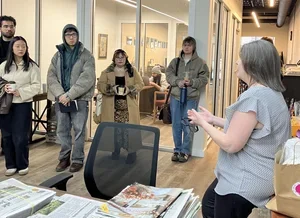
The course was created through a grant partnership with the Center for Community News at the University of Vermont.
“The aim is to support local journalism and for students to have an opportunity to write and have published articles in local papers or online,” said Campion. “The other objective is to cover shared interests that would bring people together during these politically divisive times.”
Eberwine arrived at Bennington with significant journalism experience. He interned in public relations for Kentucky’s Department of Education, wrote for his school newspaper, and published op-eds with ACLU Kentucky. Journalists he met would try to talk him out of joining the field.
“‘You should become a teacher; that's better job security,’” he recalled one journalist telling him. The warnings continued. He could count on low pay, long hours, working late every Saturday, and covering grisly crimes, they said. His stubbornness, Eberwine said, and the allure of doing different and sometimes unpredictable work each day kept him interested in the field, despite the warnings.
“This class has been a reprieve from that,” he said. The journalists who visit are candid but not cynical. “They had a lot of positive things to say about this industry, and it's just affirming to be told to go after what I want to do.”
Throughout the class, Eberwine saw the other intrinsic benefits and the societal value of being a journalist.
Early in the term, the class visited the Bennington Banner’s office on Main Street. There, reporters described covering an U.S. Immigration and Customs Enforcement (ICE) raid in Manchester, Vt.
“The local paper was he only resource that people could get,” said Eberwine. “Journalists went door to door to see what neighbors had to say about what had happened. That was valuable insight for someone who wants to become a journalist.”
“Local journalism is the heartbeat of a democracy. It's the heartbeat of a town, especially a small one. People enjoy seeing themselves in a paper,” said Eberwine. “But it also serves as an important touchstone, and we've gotten to learn that in this class.”
For his first class assignment, Eberwine attended a gallery opening for the exhibition Everyday Horrors at the Left Bank in North Bennington. It required him to walk into a room full of strangers and start asking questions.
“And it was, of course, nerve-racking,” he said. “It always is. Most journalists are introverts in some way, which is hilarious. Your entire job is going up to random people and asking them to say what they feel.”
He ended up enjoying the artwork and people’s reactions to it. His piece about it was published in the Bennington Banner.
Bennington College can sometimes feel isolated from Bennington, the town, Eberwine said. “This class provided an amazing opportunity to work more in the local community. I think this is the other power of journalism. You're not just illuminating the world for others; you're illuminating it for yourself."