Our World on Fire
Investigative journalist Francesca Lyman '72, author of The Greenhouse Trap: What We’re Doing to the Earth and How We Can Slow Global Warming, shares her work on and research into the climate crisis.

Tell me about when you first realized that the use of fossil fuels was causing harm?
Growing up in Chicago under yellow skies, breathing carbon dioxide and smog that ranked second only to New York City at the time, I came of age when it was virtually impossible not to be aware of the "environmental crisis."
As a kid, I remember watching with my family the topical TV show That Was The Week That Was with Tom Lehrer plunking out his song “Pollution” on the piano. He had some sardonic advice for foreign tourists: “If you visit/ American city/ You will find it very pretty/ Just two things of which you must beware/Don’t drink the water and don’t breathe the air.”
When the polluted Cuyahoga River in Cleveland caught fire in 1969, and a massive oil spill washed up in Santa Barbara and California beaches that same year, there was undeniable evidence that fossil fuels was causing harm.
As for the threat posed by fossil fuels modifying the climate on a planetary scale, most Americans, if they knew about "the greenhouse effect" at all, saw it as a distant concern. Scientists and policymakers were certainly aware of the threat, years before we Bennington students celebrated the first Earth Day, I would learn later. But in his Earth Day 1970 commentary, Walter Cronkite invoked the apocalyptic perils of planetary pollution: “Those who ignored Earth Day, well that’s one thing. Those who ignored the crisis of our planet, that’s quite another.”
My first glimmers of understanding about carbon dioxide pollution didn’t come until 1979, in the midst of the second Oil Shock. Strangely, my deep dive into the issue came while writing a feature story about the Great Hudson River festival in Croton, NY, as a rookie reporter for The Record newspaper of Hackensack, NJ.
Struck by displays of solar panels and wind turbines–and warnings about the Indian Point nuclear reactor a few miles upriver–I began paying attention to the Carter administration’s support for a transition to renewable energy. Having written a front-page story on radioactive waste moving on trucks through Northeast interstate highways, my developing interest in energy and environmental topics led me to work for Environmental Action magazine in Washington, D.C. as an editor.
My education in climate science began there, too, also unexpectedly.
One evening, I was working late at the office alone when a call came in from NBC News chief meteorologist Bob Ryan. He asked if anyone at the organization, or among other groups, was working on the issue of “the greenhouse effect.”
No one was, to my knowledge. Most environmental advocates at the time were focused on nuclear weapons proliferation, nuclear war, acid rain, pesticides, and toxic chemicals.
I decided to investigate.
I ordered every government report I could find from NASA, NOAA, EPA, the Department of Energy, USDA, and even the Pentagon. The stack reached my waist (this was a pre-digital age!). Together they painted a remarkable picture of future rising global temperatures, devastating wildfires and drought, sea level rise, flooding, and profound disruptions to Earth's climate systems. One study even explored how the melting ice could cause wobbles in the Earth’s rotation. The science was sobering—and went back 30 years or more.
Why, I wondered, wasn't this receiving far more attention?
The result was a cover story for Environmental Action magazine titled, As the World Warms: It's Time to Do More Than Think About the Greenhouse Effect. I was also interviewed by Bob Ryan on NBC News.
The article asked if the greenhouse effect would become the global disaster scientists had long predicted or merely a changing climate we could all adapt to. Even then, experts warned that relying on adaptation alone would prove to be a costly and irreversible mistake.
It led to my writing an early book on climate change, The Greenhouse Trap, with the World Resources Institute, published in 1990.
Looking back, I realize how fortunate I was to learn about this issue early. It is little comfort, however, knowing that the scientific projections from the 1960s, 1970s, and 1980s proved so accurate.
Thinking about how long I've known that fossil fuels were driving this crisis—nearly half a century—sometimes makes me joke that I feel like a fossil myself. But the joke quickly fades. The real tragedy is that in the 1970s and 1980s, there was still time to change course. We understood enough to begin reducing our dependence on fossil fuels before the consequences transformed the world we are living in today.
How did your book, one of the first on the subject, come about?
The Greenhouse Trap: What We’re Doing to the Earth and How We Can Slow Global Warming (Beacon Press), done with think tank World Resources Institute scientists and policy experts, including Irving Mintzer, Kathleen Courrier, and James MacKenzie, was one of the first mass-market books about global warming. Written in the late 1980s, it was published initially in January 1990, in hardcover; then rolled out in paperback in April 1990, timed to the anniversary of the first Earth Day. I’m happy to say that it is still in print.
World Resources Institute published a series of trade books on the global environment “to help Americans grasp the big picture” and in order to “dispel confusion” about the complex scientific topics of “the greenhouse effect, the loss of rainforests and biological diversity….energy alternatives and other concerns that newspapers and television usually cover piecemeal.”
The head of the organization, James Gustave (“Gus”) Speth, who founded the organization in 1982, had always made climate change a central focus. Speth had been an advisor to President Jimmy Carter and chair of the Council on Environmental Quality in his administration.
By the end of the 1980s, much like the summer of 2026, with its raging wildfires and collapsing glaciers, the issue of climate change captured people’s attention as never before.
The summer of 1988 was the hottest and driest in history at the time, kicking off heat waves and a horrendous drought across American farmland region that was the worst since the Dust Bowl. That June, Congress held hearings on the topic of manmade global warming, one of the first times that the issue had been addressed.
Climate scientist James Hansen of NASA’s Goddard Institute for Space Studies testified before a U.S. Senate committee that the most searing heatwaves and drought of the century were just a warm-up for what’s to come. Shocking the public, he claimed that he was “99 percent certain” that the continuing rise in global temperatures of the past decade was not a random event but a “signal” of the projected warming trend. “The greenhouse effect has been detected, and it is changing our climate now,” he testified.
After years of routine science reports of a possible "greenhouse" problem decades into the future, the topic was prominently covered in the media as an emerging challenge in the present. Newspaper headlines screamed “The Heat is On,” “Feeling the heat,” and even, “Is the world coming to an end?”
Of course, Hansen’s testimony confirmed what EPA and other agencies had warned about, developments that I’d covered for Environmental Action magazine. In 1983, for example, the EPA issued a report, “Can We Delay a Greenhouse Warming?” predicting dire consequences from the global warming of the Earth, including changes in weather patterns, that would cause rising oceans and flooding in certain regions, drought in others.
WRI’s publications director Kathleen Courrier had been urged by the marketing director publish a series of popular mass market trade books, rather than in-house technical or specialized publications. One was on tropical deforestation (Trees of Life), another on automobiles (Car Trouble). She reached out to me because I had been writing about global warming very early on.
To my delight, WRI rolled out The Greenhouse Trap first; it sold 10,000 copies almost immediately, calling for a second printing.
The book is a primer on the then-emerging climate crisis that explains the science behind the "greenhouse effect," as it was mostly termed in the 1980s, the history of the relationship between global warming and the Industrial Revolution of the mid-19th century, and the policy strategies for attaining climate stability.
What was the evidence of global warming at the time? Six out of the ten years of the decade evidenced the highest global average temperatures of any on record during the last century. Plus, a string of climate anomalies occurred in the United States and around the world, including a devastating drought in the Midwest in 1988, with poor wheat yields; record heat in Western states, and a rash of forest fires, plus a particularly forceful Hurricane Gilbert in the Caribbean, a heat wave that killed 1,200 in Greece in 1987, and other extreme weather disasters that claimed lives in India, China, the Sudan, and Bangladesh.
The book describes how scientists are measuring the accumulation of greenhouse gases in the atmosphere and how humanity contributes through coal, gas, and oil development, recommending changes in fuel usage and a wide array of ways to conserve energy and expand carbon "sinks" by planting trees and turning to other natural defenses.
One of the main drivers of publishing this series was that the 1990s were thought to be the "decade of the environment," when environmental awareness became a topic for college curricula and textbooks. Environmentalism was revived as a trendy cultural phenomenon. The fight to save the planet was part of a Zeitgeist, reflected in a green wave of movies and animations, with shows like Captain Planet and the Planeteers, Ferngully: The Last Rainforest, and others across the world.
“The fate of the planet began to loom large in people’s minds. Educating the rising generation to protect the earth’s resources became a top priority of the environmental movement, and cartoons became a compelling tool for fostering change,” according to the British Film Institute.
The UN issued its first report on climate, as the Earth’s population swelled to 6 billion humans. Deforestation, carbon emissions, and ecological disasters rose in tandem, as species declined and the ozone developed a "hole," and we witnessed one of the largest oil spills ever, the Exxon Valdez.
The book did well and received good reviews, among them on the front page of the New York Times Book Review. However, the reviewer assigned to the book, Nicholas Wade, cautioned that the book lacked evidence that global warming had actually begun.
He wrote: “But is the globe really warming? Most climatologists believe there is utterly inadequate evidence that greenhouse-induced warming has yet begun–a point that might have received more emphasis in a book of this quality.”
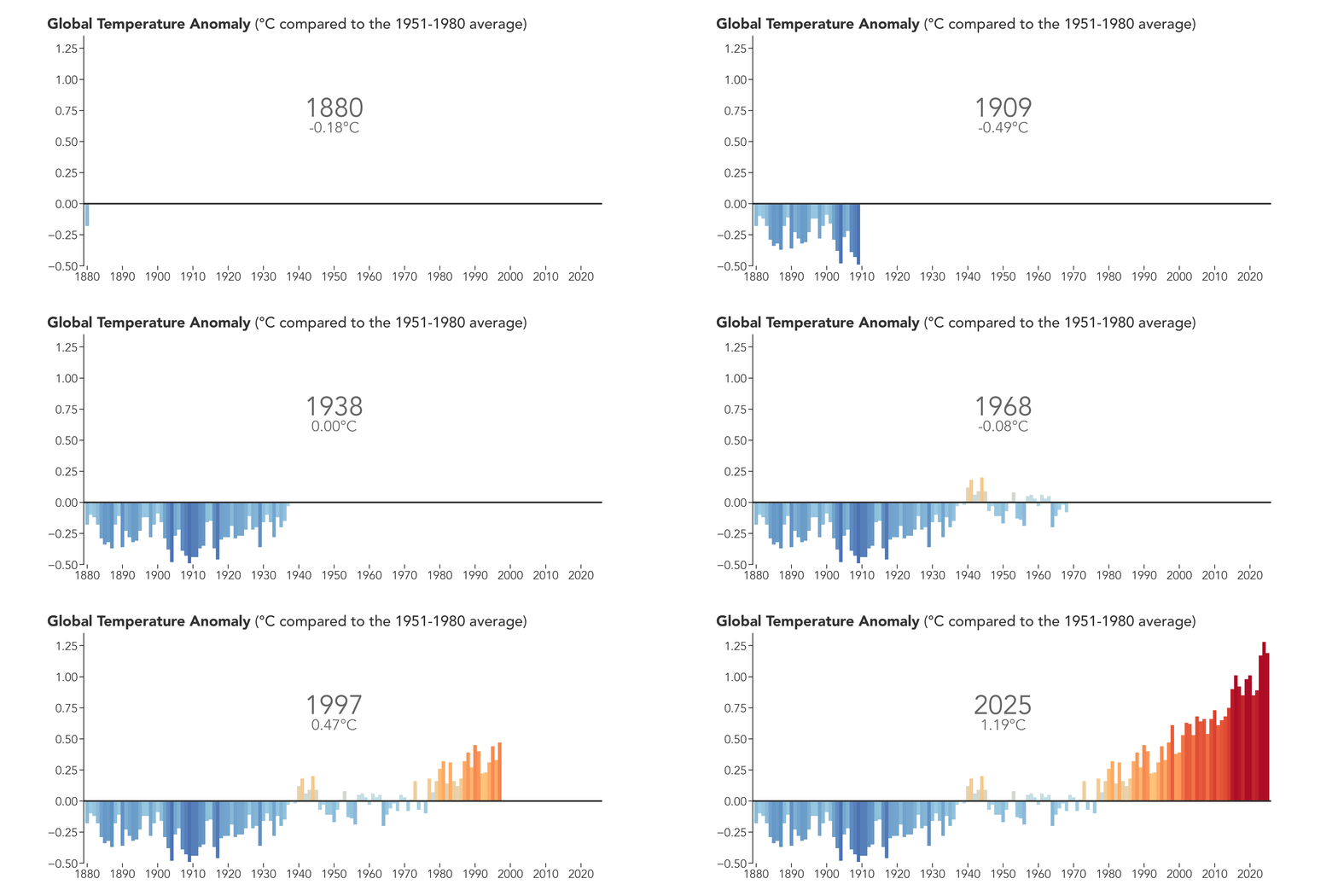
The book’s reference to a variety of signs of warming in the 1980s is very measured, while pointing to historic drought, hurricanes, and other disasters. In fact, the book never states that scientists agree that an anthropogenic greenhouse warming is unequivocally begun, simply that a pattern of temperature anomalies showed up starting in the 1980s, as an animated chart reveals dramatically.
It’s unclear if Nicholas Wade, a science writer, and former staff writer for The New York Times, was a climate contrarian but as a conservative, he was criticized in a Kirkus Review for finding fault “with nearly every aspect of progressive politics.” In later years, Wade wrote an article supporting the COVID lab leak theory, contrary to prevailing scientific views that the virus most likely had a zoonotic origin, and he fueled controversy on the topic.
It breaks my heart to see that 40-year-old video where one of the people quoted indicated that we had the time to consider how we should draw down. What are your thoughts on that clip?
NBC News affiliate’s chief meteorologist Bob Ryan, in Washington, D.C., produced a three-part series on the "greenhouse effect" that aired in fall 1983, in which I participated.
“The debate on what to do about the ‘Greenhouse Effect’ is heating up,” announced Ryan in this clip. It came on the heels of an EPA report that warned of the globe being blanketed in heat-trapping greenhouse gases.
Ryan wasn’t alone. All three national news networks covered the EPA report, “Can We Delay a Greenhouse Warming?” at the time, and PBS Nova produced a documentary The Climate Crisis the same year.
At the time of this broadcast, decades of research on climate had already warned of the dangers of inaction. A 1979 report, named after scientist Jule Charney, concluded that the science was settled: “We now have incontrovertible evidence that the atmosphere is indeed changing and that we ourselves contribute to that change.”
The scientists Ryan interviewed presented a starkly different stance; their reactions were bewilderingly noncommittal, by comparison.
“One has to weigh the costs of using less effective energy than the fossil fuels versus the potential damages,” declared John Perry, a scientist on the Atmospheric Sciences board at the National Academy of Sciences.
It’s true that energy alternatives to coal, oil, and gas like solar and wind were yet to be fully developed.
Yet the mission of the NAS, a private organization established by Congress (and signed by Abraham Lincoln in 1863), is to offer objective scientific and technical advice to the government: pure science, not cost-benefit economics.
I was disappointed to hear this and other sound bytes, because, in hindsight, so much scientific study had and policy work had gone into this issue in the 1970s.
Only a few years before, for example, the Carter administration had funded research into solar, wind and renewable energy, including the Solar Energy Research Institute, which would be later dismantled under Reagan. Carter introduced the National Energy Act to tax gas-guzzling cars and offered incentives for investing in wind and solar energy.
Just after assuming the office of the presidency, Carter received a famous memo from his science advisor Frank Press, a geophysicist, explicitly describing the “Carbon Dioxide Hazard” with fossil fuels’ potential for creating “catastrophic” disasters such as “large scale crop failures.” His projections were remarkably on target.
In response to such advice, Carter set a goal that, by the year 2000, 20 percent of America’s energy should come from renewable sources.
The other expert quoted on the NBC program reflected the Reagan administration’s deregulatory energy shift. A new Reagan administration appointee, Fred Koomanoff, director of the Department of Energy’s climate program, argued that it was premature to recommend any new energy policies. He said, “We’re not at a point—thank God!—that we’d have to take action.”
Later the Reagan administration would give a symbolic signal to the public of its changed energy priorities in 1986 by removing the solar hot water heaters Jimmy Carter had installed on the roof of the White House in 1979.
Carter, who had famously been carrying out the "soft path" of his Department of Energy advisor Amory Lovins, said, in an oft-quoted statement: “A generation from now, this solar heater can either be a curiosity, a museum piece, an example of a road not taken or it can be just a small part of one of the greatest and most exciting adventures ever undertaken by the American people.”
That turned out to be a road not taken, of course.
What was particularly sad in viewing this news clip of 1983, was discovering that John S. Perry in 1981, two years before, had authored an article “Energy and Climate; Today’s Problem, not Tomorrow’s.” In it, Perry concluded: “The problem is already upon us; we must learn very quickly indeed.” Thus, he argued, ‘Climate change is not a matter for the next century; we are most probably doing it right now.”
Tragically, Perry would be proven right. Today, the EPA’s 1983 projections about global warming, from sea level rise to melting glaciers to catastrophic flooding, hurricanes and chaotic climatic extremes, have already come true.
Moreover, today, catastrophic climate change is unfolding faster and more fiercely than scientists expected. According to climate scientist Kate Marvel at Project Drawdown, “climate change is driving unprecedented extreme weather around the world, from catastrophic floods and prolonged droughts to blistering heat waves and raging wildfires.”
Bear in mind that in the early 1980s, the carbon in the atmosphere was about 335 ppm (parts per million) – 19.64% just under 20% higher than it had been during the Industrial Revolution, when it was about 280 ppm. Today, carbon in the atmosphere is charting at 428.69 ppm. In other words, carbon in our atmosphere has increased by a factor of 1.5: now more than 50% (52.14%) higher than before the Industrial Revolution. At this rate, by the end of the century we could reach up to 600 ppm or more, according to other projections.
That is important, scientists say, because the scale and the speed at which we are polluting the atmosphere is putting us into a global experiment for which we have no understanding or basis for understanding.
“Regardless of exactly how many degrees the temperature changes, it’s clear we have already brought the planet into a range of conditions never seen by our species,” said Gabriel Bowen, a professor at the University of Utah who co-authored a study on the geological record of carbon going back 66 million years, quoted in a Columbia University Climate School news release. “It should make us stop and question what is the right path forward.”
Where do you see the missed opportunities to reverse the climate crisis?
This past summer of 2026, the world watched hundreds of thousands of people evacuated or displaced by raging wildfires across Europe, heat waves across the U.S., and devastating floods worldwide, including the catastrophic collapse of a glacier in Nepal. It was the hottest season since record keeping began in 1850, and, by one count, it has claimed more than 35,000 lives.
“We have entered a new age of climate extremes,” according to the World Meteorological Organization.
This begs the question: Could we have done something to prevent this years’ back? I was reminded of how scientists cautioned decades ago that by the time the impacts of the greenhouse effect would become unmistakable, it would be dangerously late to curb fossil fuel use.
One of those scientists was James Hansen, who testified in 1988 that the world was moving in a dangerous direction by failing to curb greenhouse gases. As media reports exploded with news that “global warming had begun,” with mounting concern, by the end of that year, some 32 bills related to climate had been introduced in Congress.
Forty years ago, however, that window of opportunity was lost. Nothing came of those pieces of legislation in the 1980s.
Fast forward to today. An even more devastating pattern of golden opportunity, followed by dashed hopes, played out with the election of Donald Trump in 2024, who notoriously calls climate change “a hoax.”
Upon returning to office, President Trump promised to “unleash American energy,” having campaigned to the oil and gas executives invited to Mar-a-Lago with a promise to deregulate their industry in return for $1 billion in contributions.
Trump filled his cabinet with officials closely tied to the oil and gas industry (or known for their climate denial), shuttered key climate programs and budgets, and gutted former President Biden’s 2022 Inflation Reduction Act (IRA), the first and only real U.S. climate law. The IRA would have slashed greenhouse gas emission by giving out tax credits, loans, subsidies and other measures to become more energy conserving and to switch to sources of carbon-free energy. Likewise, he has promoted energy-guzzling and water-depleting Data Centers, saying “Let Data reign!”
Reversing years of progress on the world stage, the Trump administration also pulled the United States out of the Paris Agreement and the United Nations Framework Convention on Climate Change, undercutting our country’s longstanding scientific leadership.
Today, the United Nations’ COP 31 (Conference of the Parties) is meeting in Turkey, with 200 nations are coming together to agree on ways to address the climate crisis, with strategies for bringing down fossil fuel emissions, it becomes clear that we have little time to waste.
However, decades since the United Nations began trying to address this issue, there is still no dedicated global treaty to address regulating fossil fuels.
In October 2026, the UN Environment Program warned that the world needs to cut carbon emissions by nearly a fifth in the next four years, and by close to half within a decade, to avoid overshooting climate targets by a disastrous margin.
How much easier this would have been, had the United States, historically the largest carbon emitter over the decades, begun addressing the growing buildup of carbon in the atmosphere 50 years ago! Remember how in the 1970s, President Carter had set a goal that, by the year 2000, 20 percent of America’s energy should come from renewable sources?
Well, Gus Speth speculates in his book They Knew: The Federal Government’s 50-Year Role in Causing the Climate Crisis how things could have been different. If Jimmy Carter had been re-elected, with his pro-renewables agenda— and continued after his administration—the United States hypothetically could have been on a path—through sensible reductions in oil, gas and coal—of curbing greenhouse gases.
However, that scenario did not come to pass, and an attitude of climate denialism persisted for decades, beginning with President Ronald Reagan in the 1980s. In fact, our carbon emissions went up in that 40-year period.
So, looking back, there has been a half century of inaction and missed opportunities since the 1970s, when a consensus solidified among scientists that the impacts of climatic changes would be substantial by the middle of the 21st century, 2050.
Virtually nothing has changed in the basic understanding of the science since then.
A group assembled by meteorologist Jule Charney studied the effect of carbon dioxide and other heat-retaining gases on our atmosphere and natural earth systems, releasing the famous Charney Report in 1979. They pointed out that the ocean, “the great and ponderous flywheel of the global climate system,” could slow the course of the “observable climatic change.” However, they added: “A wait and see policy may mean waiting until it is too late.”
The Department of Energy echoed the Charney Report’s warnings, a year later, in July 1980, writing, “It is the sense of the scientific community that carbon dioxide from the unrestrained combustion of fossil fuels is potentially the most important environmental issue facing mankind.”
Rafe Pomerance of Friends of the Earth, one of the few environmental advocates working on climate at the time, told me much the same thing in early 1984, at a time when “the Fate of the Earth” consumed the environmental movement: “There’s no environmental problem that compares with nuclear war, but second to that, carbon dioxide’s at the top of the list.”
Pomerance had been instrumental in urging policymakers to pay attention to the looming dangers of climate change. And he saw a line of steady progress by the end of the 1980s to the threat described in a June 1979 report to the President’s Council on Environmental Quality, which concluded that “Man is setting in motion a series of events that seem certain to cause significant warming of world climate, unless mitigating steps are taken immediately.”
In an appendix to The Greenhouse Trap, Pomerance presented a timeline of “Greenhouse Politics.” Pomerance’s listicle ticks through reports, international conventions, quotations from politicians, (including, surprisingly, Republicans,) between 1979 and 1989 that together show an auspicious sense of bipartisan—and global—agreement in addressing climate change.
A clear set of reports and events marked largely forgotten milestones of progress:
- In January 1988, President Ronald Reagan signs the Global Climate Protection Act, requiring the president to propose policy responses to Congress.
- In August 1988, president candidate George H.W. Bush, [who campaigns as the "environmental president," at the time] declares that “those who are worried about the greenhouse effect are ignoring the White House effect.”
- In June 1986, Following Senate testimony by James Hansen, Sen. John Chafee, [R—RI] asks EPA and the Office of Technology Assessment, to develop policy options for greenhouse gas concentrations.
- In May 1989, having been elected, President George H.W. Bush announces his support for the negotiation of a climate convention, as U.S. negotiators invite delegates of the newly established Intergovernmental Panel on Climate Change to discuss such a convention.
- In November 1989, at the first ministerial meeting on global warming, hosted by the Dutch government, where 60 nations convene, “industrial nations agree that carbon dioxide emissions should be stabilized as soon as possible.”
Imagine a Republican senator today convening hearings to address public concern on climate!
While it’s not mentioned in this timeline, Republican Sen. Chafee, as Chair of the Senate Environment and Public Works Committee, had convened two-day hearings on global warming in 1986. In his opening statements he said the following:
“To my mind, the risks are so great that we must avoid continuing on a path that will irreversibly alter our environment unless we know that it is safe to proceed down that path. Scientists have characterized our treatment of the greenhouse effect as a global experiment. It strikes me as a form of planetary roulette.”
In recent years more attention has gone to studying these ‘missed opportunities’ of the 1980s. Nathaniel Rich’s book, Losing Earth traces in detail that "lost decade" and throws a spotlight on Rafe Pomerance’s behind the scenes efforts to move the chess pieces forward. The book is being made into a movie. Meanwhile a documentary film, The White House Effect, profiles George H.W. Bush’s early embrace of climate science, only to retreat from that position.
What can we learn from the mistakes of the past? The message then, forty years ago, as now, is the same: If we fail to act soon, we do so at our own peril.
Climate scientist James Hansen said it plainly in a TED talk in 2012, “The longer we wait, the more difficult and expensive it becomes.”
“If we had started in 2005, it would have required emission reductions of three percent per year to restore planetary energy balance and stabilize climate this century. If we start next year, it is six percent per year. If we wait 10 years, it is 15 percent per year—extremely difficult and expensive, perhaps impossible. But we aren't even starting.”
This is where we are now.
Since I was born, global fossil fuel consumption has increased roughly eightfold. Since I first immersed myself in the issue in the early 1980s, it has approximately doubled. The future climate scientists described then has become our present.
What is our best hope going forward?
In September 2026, the United Nations acknowledged that the Earth has lost its chance to avoid some of the worst harms attached to climate change, likely breaching the 1.5 deg. C, 2.7 deg. Fahrenheit, threshold.
"Humanity is speeding past the limit to avoid climate catastrophe," United Nations Secretary-General António Guterres warned.
Given this new vantage point, instead of achieving a long-promised milestone of 1.5 degrees, now the U.N. said it wants policymakers to "prepare for and navigate a future'' in which the globe crosses that limit and then corrects course and cools temperatures.
With this sobering outlook, the question “Where is our best hope?” may seem impossible to answer. But there is cause for hope. Yes, according to UN officials, the world likely will be in that overshoot period for "many, many decades."
If the problem is this entrenched…If the system is this resistant…If the past is this compromised…What can possibly change?
The answer is that a lot already has.
First, the public is far better informed than it was decades ago. Awareness of the dangers of fossil fuels, and the disinformation surrounding them, has grown phenomenally. While there’s more need for public education, climate action is increasing, including here in the United States.
Second, the world’s energy system is advancing and reducing emissions from power generation and, to a lesser extent, heating and transportation. According to Pew Research, “Worldwide, 57% of all electricity generated in 2025 came from burning coal, gas or other fossil fuels, down from 65% in 2000.”
While the world is using more electricity, the sources of this energy are changing. “Renewable sources like wind and solar power are growing rapidly, especially in certain parts of the world,” according to Pew.
Coal use has declined from 41% to a third of all global electricity. By contrast, wind and solar power account for a rising share of global electricity generation. These two sources together accounted for 17% of all global electricity in 2025, compared with less than 5% in 2015.
“Clean energy” is no longer just an environmental argument. It is increasingly an economic one. Renewable energy—solar, wind, battery storage—is becoming more competitive, more scalable, and more widespread. According to Pew, “in 2025, renewable sources – wind, solar, bioenergy, hydropower, geothermal, tidal and wave – accounted for a slightly larger share of global electricity production than coal for the first time (34% vs. 33%).”
A June report from the United Nations Environment Program (UNEP) highlights several other reasons for hope in the fight to slow and eventually stop carbon buildup.
Electric vehicles are accelerating into the mainstream. In 2025, electric vehicles accounted for more than a quarter of global new car sales, up from less than 3 per cent in 2019, the organization reported.
Buildings are becoming more energy efficient. While big enough strides still aren’t being made, there’s vast potential here for energy efficient technology .
Heat pumps are transforming how we heat and cool buildings. These systems use much less energy than conventional gas and oil furnaces.
Finally, cutting food waste offers one of the fastest climate wins. Food systems account for around 30 per cent of global greenhouse gas emissions, while roughly one-third of all food produced globally is wasted. Cities are starting to address this through waste reduction and food redistribution systems.
While there’s hope, we face a narrower and narrower window of time to catch up to the changes the world is creating for us.