Restorative Justice Circle Plants New Seeds
On Saturday, March 14, Linds Leggett ’27, along with facilitators Beatrix Sherry ’26 and Carissa K. Lombardi '26, joined nearly a dozen participants in the Admissions Parlor for a restorative justice circle combined with succulent planting. The event, part of the Restorative Justice Collective’s Pi Day celebration, centered on building community.
Pi Day, March 14, celebrates the number 3.14, the mysterious never-ending figure that represents the relationship between a circle’s circumference and its diameter. Like pi, circles are integral to restorative justice, where participants sit in a circle around a centerpiece that grounds the practice. They pass a talking piece to set and uphold agreed upon community norms.
Leggett began by explaining what restorative justice is and how it is used. The practice is based on those that originated in indigenous communities. Beyond building community with activity or get-to-know-you circles like this one, restorative justice principles can be used to resolve small conflicts or repair harm caused by crime or wrongdoing, in which case the practice focuses on the needs of victims, holds offenders accountable for their actions, and involves reintegration into the community. Restorative justice offers reparation as an alternative to going through the punitive legal system.
Leggett became aware of restorative justice when it was mentioned on one of her favorite shows (Good Trouble) and in literature she was reading.
“I knew that it was something I wanted to study in college because I was starting to do a lot of unpacking of my own privilege,” said Leggett. When she saw it in Bennington’s curriculum, she thought, “I have to get into that class.”
While she was apprehensive at first, thinking that it would be really hard, she was immediately put at ease by former faculty member Alisa Del Tufo and Bailey A. Fox ’21, who is still at the center of the work. “From the first week, I thought, ‘this is a dream.’ I remember feeling so grateful and engrossed with the fact that I had access to this. The fact that the principles were so simple and humane made me even more interested in what it could do.”
She learned that the Restorative Justice Collective started in 2021 and has been carried forward by students India Rose Carter-Bolick ’23, Ade Bryon '24, Elizabeth N. Pollom '25, and others. Throughout that time, students read the foundational texts, conducted community-building events during orientation and like this one, and have trained to work through campus conflicts, between roommates, for instance.
They also learn how it works, both in the campus community and in the wider world. “When implemented at every level, restorative justice is shown to drastically reduce recidivism, harm, crime, and the feeling of loneliness and isolation in communities.”
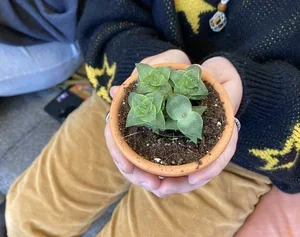
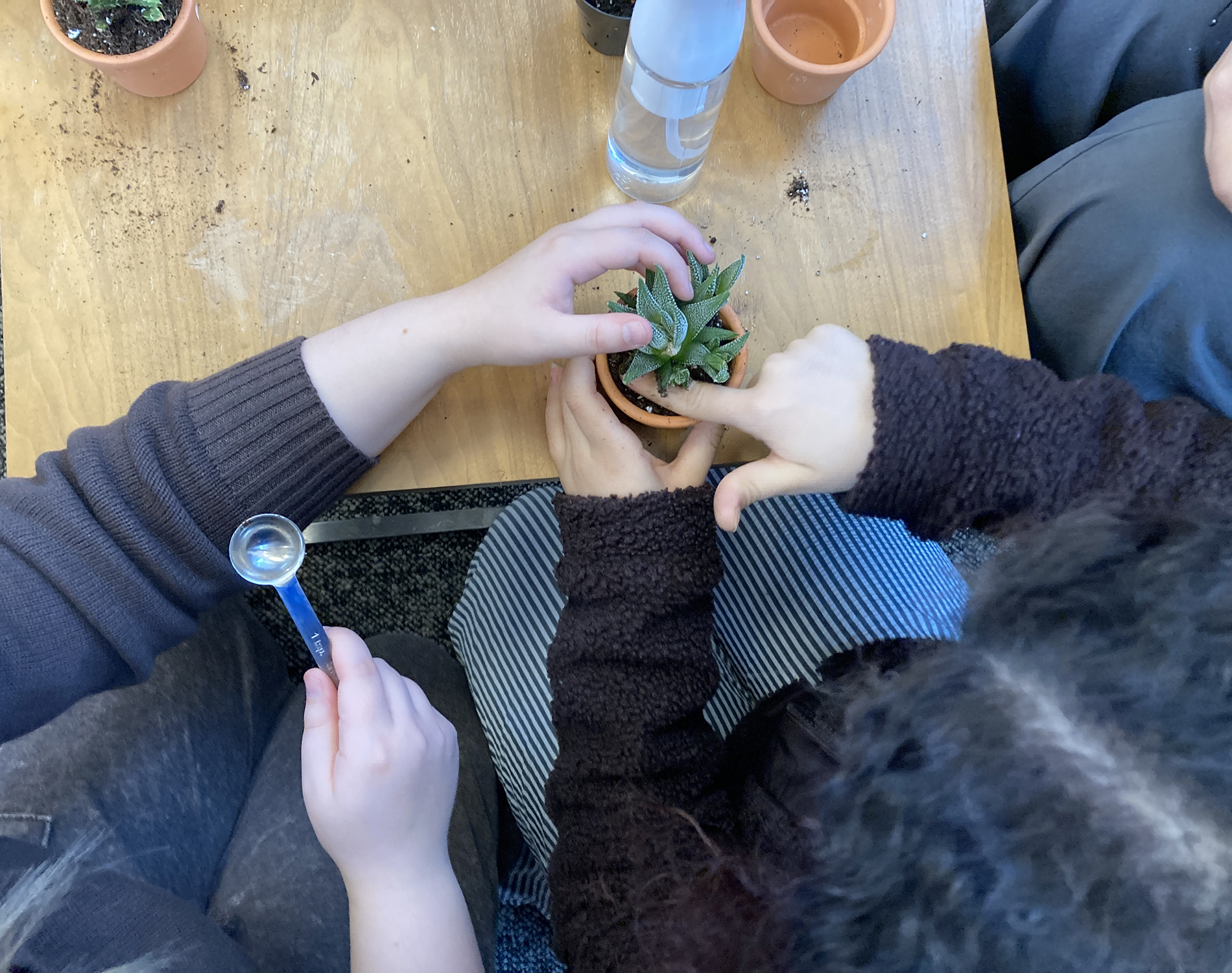
Gathered around a table of soil, pots, and plants, Leggett read the collective’s humanity statement and opened discussion of rules for engaging. The group moved onto ice-breaker-style questions. Because this event involved planting, Leggett focused on questions about plants and nature. “What is your most salient memory of nature?” and “What is a weed in your life at this time?”
The answers ranged from somewhat superficial to startlingly deep. Several participants spoke of their grandparents teaching them to garden and the desire to overcome lifelong vulnerabilities. Recognition of common interests and weaknesses could be easily seen in the faces of those around the circle, and it was gratifying to see members of the group acknowledged and validated.
The participants definitely knew each other more personally and had experienced restorative justice in an engaging way by the time they left, carrying their plants with them. Leggett has been invited to do a restorative justice planting booth at Sunfest. “The demand of this circle feels surreal,” she said.