Reunion Find: Deborah Elizabeth Finn '81's tribute to faculty member in social science Ron Cohen
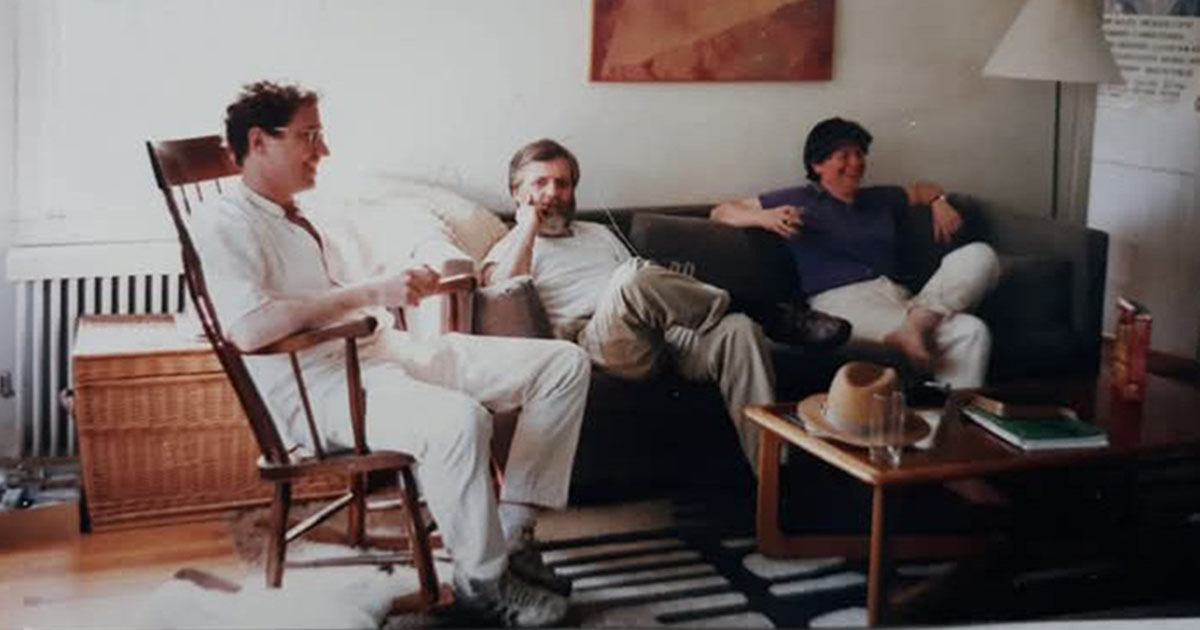
Over lunch on the Saturday of reunion weekend, October 4, Deborah Elizabeth Finn '81 remembered a letter she wrote to recommend her favorite Bennington teacher Ron Cohen for a teaching award from the Society for the Psychological Study of Social Issues. The letter reveals much of what it was like to be a student with Ron Cohen then and something of the faculty-student mentorship culture that endure today. The letter appears below along with Ron's humble and humorous response.
Dear Members of the SPSSI Teaching Award Committee,
It is a pleasure and a privilege to write in support of Ronald L. Cohen's candidacy for the Society for the Psychological Study of Social Issue's award. I am merely one of untold numbers of former students whose lives he has profoundly affected.
My first experience of Ron's exemplary teaching occurred when I enrolled in his course on “Socialization” at Bennington College. I can honestly say that - although I was still confused about the meaning of socialization at the end of the semester – I have never stopped learning and thinking about it. Ron's pedagogy in this course, and in all the courses I subsequently took with him, was brilliantly crafted to introduce me to the soul of the discipline of social psychology, rather than to a limited set of his own shibboleths. Instead of assigning introductory textbooks, Ron challenged the class to read Sigmund Freud, Erik Erikson, Talcott Parsons, Jean Piaget, Rosabeth Moss Kanter, and Erving Goffman. (In subsequent courses, we also read Emile Durkheim, Peter L. Berger, Karl Marx, C. Wright Mills, and Max Weber in lieu of standard textbooks.) It was tough going for my nineteen-year-old self, but he imbued members of the class with the confidence to critique these great social thinkers as if we were their peers, and to challenge his own thinking as if we were not only his students but his colleagues.
In the years that have passed, I have had many occasions to realize, with deep gratitude, that Ron provided me with many conceptual pegs on which I could hang the experiences and insights of a lifetime. My range in my teens and twenties was necessarily limited, but it seems that Ron taught me and my fellow students with an eye to the future. With every course he taught, the semester ended, and the real learning continued. As a participant in Bennington College's Non-Resident Term program, I completed two sojourns at other undergraduate institutions that offered social psychology curricula (Yale and Stanford); sitting in on courses there, I was stunned by the comparative poverty of those classroom experiences.
In my first year as a graduate student at Harvard, a professor pulled me aside in the library to say, “I'm so proud to say that you're my student! Everyone else in the seminar just sits there and takes notes!” She was particularly pleased that I had engaged in dialogue with a visiting professor during the seminar in a friendly but challenging manner. I learned how to do that from Ron, and not only in the classroom. He devoted many office hours to conversation with his students, not merely holding forth, but listening carefully and supportively. His manner was sometimes playful, sometimes earnest – but respectful of our individuality, and of our struggles to grow into the adult status that he ascribed to us.
As a college student, I often disagreed with him about issues in social justice. However, as the years pass, I find myself arriving at convictions that he espoused. Perhaps he was right all along, and my experience has caught up with the maturity of his thought – or perhaps he was unusually persuasive in his techniques of not pressing hard on an ideological agenda but rather engaging in conversation that impelled me to challenge all assumptions, including my own. Either is very much to his credit.
It is also very much to his credit that our student-teacher relationship made an easy transition to a friendship between peers. He was very careful not the exploit the power imbalance when I was student. We were very friendly, but his evaluations were recorded on my permanent transcript, and I was his paid research assistant - and that is not exactly the same as being friends. When I graduated, we settled down to being friends, confidantes, and partners in dialogue.
In my post-college life, I have followed some unusual paths. My current profession is one that did not exist when I graduated from Bennington. Ron's mentorship did not dictate that I pursue a career in social psychology as a research discipline, yet I use and expand on what I learned from Ron every day of my life. As a consultant and activist, I work with many nonprofit organizations that strive to make the world a better place, empower the disenfranchised, fight for social justice, and advance the cause of basic human decency. Perhaps I will be forgiven if I boast that I have a keen sense of the role that the social construction of reality plays in social problems and their solutions. This makes me a stronger activist, advocate, and change agent. I owe much of that strength to Ron’s transformative teaching.
I recently told Ron, only somewhat jokingly, that it seems immodest for me to claim that he is an excellent teacher, because my argument is predicated on the claim that I am an excellent human being. However, that is the gift that outstanding teachers bring to their students: a transformative, life-changing relationship that informs a lifetime of growth. That is Ron's gift, and I encourage the Society for the Psychological Study of Social Issues to treasure it as I do.
Sincerely yours,
Deborah Elizabeth Finn
When Deborah shared the letter with Ron, he responded:
This is a very nice surprise.
Thank you so much for your letter; lies, all of it, but it brought me to tears.
I think the fact that I played right field in the 1956 Little League All-Star game and got a hit in my only at bat was what did the trick.
Love,
Ron