What Education Should Be
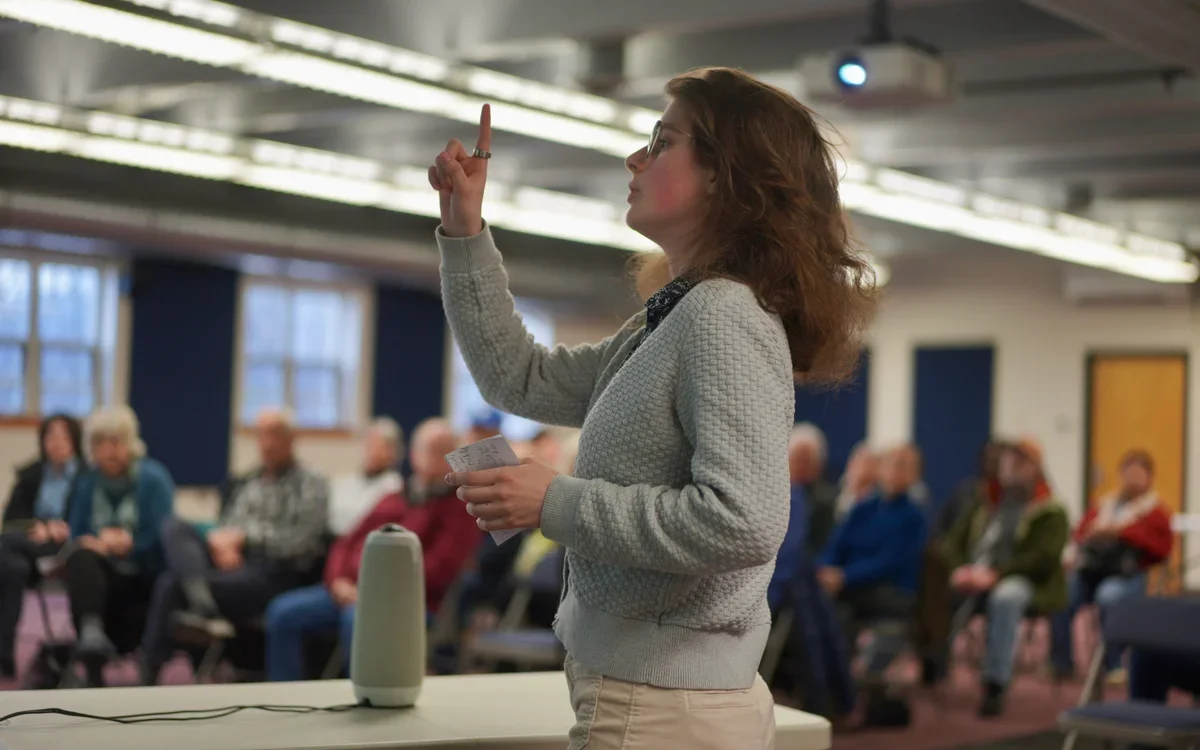
Students use data science to counter PFOA contamination.
On March 17, 2025, local community members affected by PFAS (per- and polyfluoroalkyl substance) contamination in local groundwater gathered at the Bennington Fire Facility or logged in online to hear from Bennington College students. The students had spent several months analyzing almost a decade of water-quality data collected by the state Department of Environmental Conservation (DEC). They focused on perfluorooctanoic acid (PFOA), the main pollutant, associated with ChemFab, a factory that operated in Bennington between 1969 and 2002.
One by one, students Kasha Butterfield ’26 (pictured above), Peace Kalomba ’25, August Schnell ’26, and Alejandra Vouga ’26 presented box plots and bar graphs and multicolored points on maps that represented complex spatial analyses of bedrock formations, fault lines, wind direction, and the slope of the land as it compared with levels of contamination found in local wells. Students revealed new information about the problem, including where the contamination is likely to be greatest based on the factors they analyzed, and expanded their understanding of how they can turn geological and environmental data into actionable information.
“The data was fascinating. It was different. It was messy. It wasn’t curated in the way a lot of the other stuff we work with is,” said Butterfield. “It was an interesting learning experience, and the faculty members were extremely helpful in figuring all that out.”
“It’s been super educational. It feels real,” said Schnell. “A lot of the time we engage with pretty abstract thought. It was nice to work in the real world.”
Faculty member David Bond, one of two faculty members leading the project, summarized the students’ findings. “We haven’t yet found the edge [of the contamination], and downwind is a good place to keep looking.”
Faculty member Tim Schroeder analyzed contamination data over time and had the sad duty of sharing that the problem is getting worse.
“More wells are seeing rising concentrations than falling ones,” Schroeder said. “That’s probably because a significant amount of [PFOA] remains in the soil and continues to leach into the groundwater at a steady rate. Unfortunately, that process is likely to persist for a very long time.”
One attendee asked the students, “how does the College, or you individually, use data as power to influence companies that make poison? This shouldn’t happen, and it can’t happen again. What do we do with this information?”
Schnell answered, “A lot of what we have been trying to do is just provide information to the public. Knowledge is power.”
Bond elaborated, “These findings should empower the community to ask for more robust monitoring of our wells and drinking water resources going forward.”
Richard Spiese is an environmental scientist, a hazard waste site manager for the Department of Environmental Conservation (DEC), and the College’s counterpart at the DEC. He emphasized the importance of the students’ contributions, noting that their work provides a “greater understanding of the persistence and spread of PFAS contamination using actual data.” He said that the research “strengthens evidence of responsibility” for the contamination, which increases the likelihood that the companies involved—specifically ChemFab and its successor, Saint-Gobain—will be held accountable.
“These are moments when the College has a responsibility to the community,” said Bond. “We have a set of resources, including our students and their education, to open our doors to nearby problems and actually make real contributions to the community.”
“I am grateful to have been trusted with this,” said Kalomba. “It is important for us as students to be able to use our skills, and that’s what education should be. Education is about what you learn and putting it out and having an impact on the community.”
Everyone agrees that more research is needed. “One thing that is clear is that we are at the beginning of this problem,” said Bond. “PFAS has only been detected in our community and in other communities in the past decade or two. We are just at the beginning of trying to understand what the long-term consequences of PFAS will be.”
Three of the four students are seniors in 2025–2026 and plan to continue the research for their senior work.