Martha Graham Dance Company Brings a Century of Modern Dance Home to Bennington College
The Artistic Director of the Martha Graham Dance Company, Janet Eilber, danced with the company in the 1970s, sometimes under the direction of Graham herself and in roles Graham had written for herself. Now, she has the pleasure of designing the program for the company’s first-ever performance at Bennington on Saturday, March 28.
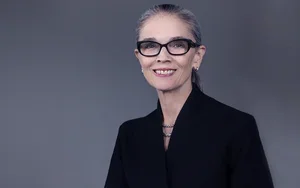
How did you first become aware of Martha Graham?
Well, I was highly skeptical at the beginning. I came to New York City and was required to take the Martha Graham technique, which I had never taken before, and I didn't understand why we had to sit on the floor for half an hour before we got to dance. And I basically skipped all of my Martha Graham classes for my freshman year at Juilliard, but then I was cast in one of her ballets, Diversion of Angels, and the light bulb went off that this was a physical vocabulary. It was brain, heart, spirit. You had to totally invest yourself in using this physicality to reveal who you were. And that was it. That is why I've been with the company for more than 50 years.
Tell us more about Martha herself.
I danced for the company in the 1970s when Martha was still very much with us and creating new works and directing us. I was lucky enough to be directed by Martha in some of her own roles and to live the Graham legacy from the inside. It was life changing to work with Martha Graham, of course. Martha could be whatever she wanted to be at any given moment. She was a creature of the theater, and as she directed us in the studio, she would understand what she needed to do to draw things out of us, to make us understand ourselves, and to bring that understanding to the process. So if you needed her to be a mother, she would be a mother. If you needed her to be a flirt, she would be a flirt, a tyrant, a tyrant. Whatever she had to do to help you understand your own power and how to invest it in a performance, that's what she did. She was eloquent and funny. She had a great sense of humor. People often don't think of that. She was about five foot one. She was tiny, but people think she was like six feet tall if they ever saw her on stage. She just had a genius insight about people, and I think that's the essence of what she put on stage, that genius understanding of looking at someone and understanding them. Basically her discoveries for the stage took body language, that understanding of how a person holds themselves when they're unhappy or happy or in love or nervous, and developing a physical language out of that for the stage.
How have you guided the company as artistic director?
When I took over as Artistic Director in 2005, I began to consider the legacy from the outside and to understand how it should be curated. We had a core collection of some of the great masterpieces of 20th century art. I was asking, how do we keep them in front of the public and speaking clearly with relevance? And a lot of that has been done through contextual programming, spoken introductions to all of our performances, media on stage, social media, unusual partnerships, and then bringing in new choreographic voices. Our programs these days are about half Martha Graham classic, half new work, and we find there's a real conversation between the classics, the thematic material that Martha Graham was dealing with and the thematic material of today's voices, as you'll see on the program that we have planned for Bennington.
Please tell us about the relationship between Martha and Bennington.
Bennington was a hugely validating place, festival, congress, if you will, bringing modern dance as it was in the 30s together. It validated the art form, because then it was still a radical new type of art, and very American, of course. So to have it brought together for creative purposes and at the same time educational purposes, these collaborations between all these artists, established modern dance in some indelible ways in the country.
And the works that Martha created while she was at Bennington, the relationships she formed…. She met Eric Hawkins at Bennington. We have letters from Martha, from Bennington to composer Henry Cowell, for example. One of the works that we are bringing to the program, Immediate Tragedy, has a score by Cowell. And there are letters with Martha talking about the Bennington premier and her mental state as she created that solo. There's just a lot of material about her relationship to Bennington and what happened there. Especially for students in dance, it's still a powerful magnet, her work at that time. It is mythic.
What are the highlights of the performance on March 28?
This is a program designed specifically for Bennington. I am aiming to encapsulate who Martha was and what was happening with her in the 1930s and also include some new work that is clearly connected to the social, political activism of the time. And it is a very American program. So I'm opening with Lamentation, Martha's solo from 1930 and its stretchy tube of fabric. That was a shot heard around the world, in terms of modernism arriving in dance. Then the students in Panorama, which is about the power of numbers, the power of people to come together to make change.
There’s an excerpt from Appalachian Spring, then a short section of a work we premiered last year, En Masse, by Hope Boykin. It has a score from recently discovered music by Leonard Bernstein that has never been heard before, and we developed it into a new work. And I want to bring the last eight minutes of that work to Bennington. Immediate Tragedy is a solo that Henry Kyle created, the music for which premiered at Bennington. And we actually have a letter. Jose Limon happened to be at the premiere and wrote several paragraphs about this solo. We will close with We the People by Jamar Roberts, which also premiered last year and is also born out of the social, political atmosphere and clearly resonates with the other pieces. The program has a lot of diverse elements, and yet they're all in conversation with each other.
You do have so much happening for the centennial of the dance company. How does this visit to Bennington fit in with the constellation of those other things?
We are celebrating all of these different aspects of our legacy. One exhibit is about the contraction and the release and the technique, and the other one is about Martha Graham's collaborators. The documentary is about today's Graham Company. Nobody else has the Bennington piece of the puzzle; that's for sure.