Small Classes, Big Research: Amanda Bacon ’19’s Bennington Education Fuels a Career in Particle Physics
Amanda Bacon ’19 came to Bennington from Riverside, California, knowing that she wanted to be an astrophysicist. But more than that, she knew physics and astronomy classes at large universities could have hundreds of students. “I wanted to be able to take my education into my own hands and not be a number,” she said on March 27 during a return visit to Bennington to share her current research as a PhD candidate in particle physics at the University of Pennsylvania.
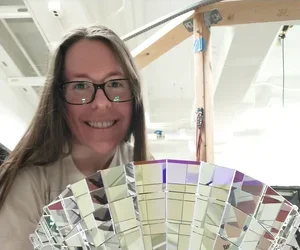
Bacon first learned of Bennington because her high school counselor was friends with a representative from the College. He explained the differences between Bennington and other institutions: small classes and the ability to shape your own academic path. Plus, there was a six-week internship every year.
“The way he described it sounded so unreal,” Bacon said. She applied, was accepted, and flew out to visit. “That’s when I met Hugh [Crowl, her advisor] for the first time.”
At an accepted students event, Crowl and current students were measuring the conversion of gravitational potential to kinetic energy by throwing pumpkins with a medieval trebuchet. “That’s when I knew this is where I had to be,” she said.
Crowl guided Bacon through the unique journey that is a Bennington education. She spent a great deal of time in the Stickney Observatory and in physics and math classes, often with just a handful of other students. The small class sizes allowed faculty members to provide extensive support and to get to know Bacon and her classmates really well. “They know you as a person and want you to succeed,” she said.
Crowl also challenged her to step outside her comfort zone by encouraging her to take literature, ceramics, and printmaking. “That has made all the difference,” she said.
“It is important to be able to approach problems in different ways and to be well-rounded. At other schools, it’s set courses, research, and a degree. At Bennington, you can be straightforward, but you can also pursue offshoots. It can be nonlinear. It was hard, but I am a better person and scientist because of it.”
Thanks to a connection forged by Madelyn J. Moberg ’16, Bacon landed a Field Work Term internship studying dark matter at SNOLAB, the deepest cleanroom in the world, in Ontario, Canada. In 2015, physicists from the SNO collaboration and the Super-Kamiokande collaboration won the Nobel Prize in physics in 2015 for discovering that neutrinos have mass. Moberg's experience encouraged Bacon to reach out by email to Joshua R. Klein, PhD, of the University of Pennsylvania, who was then the spokesperson for MiniCLEAN, a dark matter experiment at SNOLAB. Bacon later met Klein in person during her Field Work Term at SNOLAB.
“My Field Work Terms allowed me to show that I could do research,” said Bacon. “I was able to develop the research skills and show I could do it. I know my way around the lab, and I know my way around data analysis.”
Before graduation, Bacon applied to graduate schools and was accepted to two, including the University of Pennsylvania, where she eventually enrolled in her PhD program. “When you actually get to graduate school, and there are students from Harvard and Berkeley, you might think ‘I don’t belong,’ but I remembered that Bennington faculty believed that I could go on to a graduate institution and succeed. And I was accepted for a reason.”
She also took heart that Klein knew her from Field Work Term. “He knows Bennington, and he knows that I am able to do this research. That’s what propelled me,” said Bacon. “Bennington might seem like an underdog, but it produces very well-rounded people and well-rounded scientists.”
As part of her PhD, Bacon works on the electronics of SNO+, a detector at SNOLAB. She is searching for neutrinos, sometimes called “the ghost particle,” in coincidence with gravitational waves.
“If we do see this signal, that would be great! In principle, because these mergers occur at large distances, any energy-dependent time delay in neutrino arrival could be used to constrain neutrino mass,” she said.
She is also working on a research and development project toward a novel detector concept known as a dichroicon. The dichroicon is a Winston-style light concentrator built out of dichroic filters, which could allow large-scale neutrino detectors to sort photons by wavelength with small overall light loss. The dichroicon separates Cherenkov and scintillation light, which enables simultaneous measurements of both energy and directional information beyond the capabilities of current detectors.
The device aims to combine the best qualities of the existing detectors into one. Scintillation detectors offer high photon yield, which result in good energy and position resolution, but no directional resolution because scintillation light overwhelms Cherenkov light. Cherenkov detectors, by contrast, have a low photon yield and therefore poorer energy and position resolution, but they provide good directional information.
“There are pros and cons to both. The ideal would be to combine them to achieve high photon yield and good energy resolution, like scintillation detectors, along with the directional information provided by Chernkov light,” she said. “This would allow scientists to measure both energy and directional information in ways the current detectors cannot.”
When she finishes defending her dissertation this spring, she laughed, “I am going to sleep for 12 hours.” After that, she looks forward to her postdoctoral work in dark matter at Texas A&M.