Recent Graduate Karina Gonzalez Perez ’25 Empowers Youth Through Emotional Learning
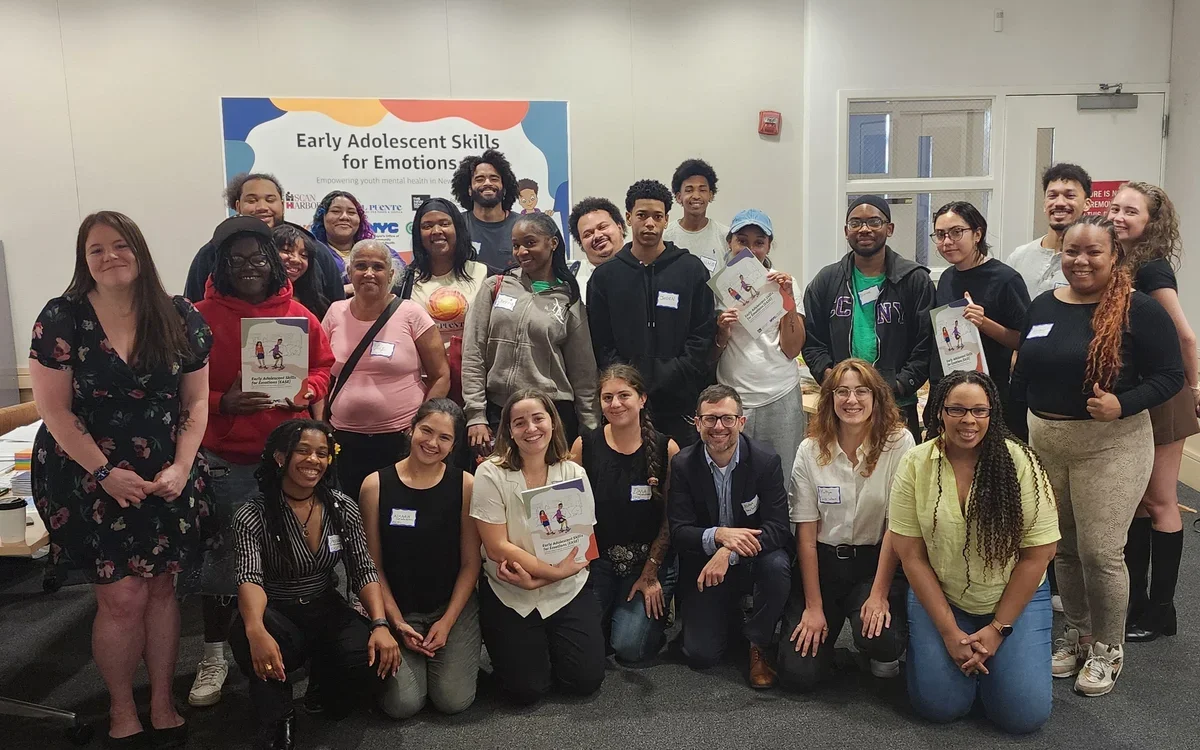
Karina Gonzalez Perez ’25, front center, holding book
Bennington College caught up with Karina Gonzalez Perez ’25, now a Research Coordinator at The New School’s Center for Global Mental Health in New York City. In this conversation, Karina reflects on her impactful work helping youth build emotional awareness through the EASE program and how her studies in psychology, education, and community building at Bennington contributed to her success so far.
Please tell us about what you are doing now.
We're implementing a mental health intervention designed by the World Health Organization for youth from 10-15 years old in New York City communities. Spring 2025 was the first group of youth that enrolled in the program and this fall was the second time we did it. This time, we have double the number of youth. So, I have to say, I do work a lot, but it's all very fun and rewarding. This intervention is known to have better results when delivered by people who know the youth. So we train people at community-based organizations in New York to be able to roll out the intervention at their sites, which are primarily afterschool programs.
Wow. That sounds great. Please describe the intervention.
The intervention is called EASE. It stands for Early Adolescent Skills for Emotions, and it's a seven-session intervention where youth learn how to manage stress, how to manage feelings that maybe they didn't really understand earlier, how they experience feelings in their bodies. Social emotional learning is embedded in the intervention. We're teaching youth that there's more to feelings than anger, sadness, and happiness. There's a big wheel of feelings that they have. There's a storybook and a workbook that the youth follow throughout these seven sessions. And there are materials that help them realize what their passions are, what they are good at, what their strengths are, just working on getting to know themselves a little bit better with the hopes this is going to help them manage their big emotions. It's a group intervention, so they do it with other youth at the same time. EASE also has a caregiver component where they can attend three sessions and they will also learn the power of praise, the importance of self-care and how to manage stress.
How closely does your work now relate to what you studied at Bennington?
Very closely. At Bennington I studied developmental and child psychology, education, and community building. In terms of developmental and child psychology, I have been able to apply the previous knowledge gained at Bennington classes with the new data we have been gathering to be able to further my understanding of theories of cognitive growth. Previous work in psychology served as a basis to help advance the existing research on child and adolescent therapy by conducting quantitative and qualitative assessments with the youth to increase the amount of data in the topic and assess the efficacy of the mental health interventions. The community building work has been really helpful when it comes to the trainings. I make sure people feel comfortable wherever they're getting trained. I do believe that community, how comfortable you feel in a space, is the basis of an effective training. There has to be a connection with other people for it to work better. I did learn a lot from Bennington, not only from my academics, but also from my own personal life there.
What experiences prepared you for this position?
As a student, I applied for a position with the Consortium of Forced Migration Education and Displacement. There were two spots for Bennington students to go to this program in Switzerland for a month. We worked with several NGOs, some asylum centers, and the World Health Organization. We were working on that even before going by writing papers and researching. The whole topic was global mental health, so we were talking about immigration and how that affects someone and how organizations in Switzerland could support people better.
There's a “before” and “after” in my life, and it was this program. It was really just life changing. And it did help me get this job because I was able to keep in touch with the director of the program, Adam Brown. He's a faculty professor at The New School, the director of the Center for Global Mental Health, and now my boss. Without the experience and connection with Adam at the study abroad program, I would not have gotten this job. I am grateful for the guidance and connection I had with my faculty at Bennington, as I know Adam and the team reached out to them. Because of the individual attention I got at Bennington, I knew my faculty very well, and that helped them be able to know my skills and strengths and how well I fit into this program.
What advice do you give current students?
I had no idea I was actually going to get the job or my visa, even as late as a month before graduating. Life just works in crazy ways. I did have the skills that I needed for the job. Obviously, Bennington prepared me to do all these things and helped me make connections. But a lot of stars had to align for me to be able to get the job. I think it was a lot of luck from my side. I was also willing to keep my options open and flexible. I was open to moving wherever I had to go. I think some people say, ‘Oh, I don't want to go here, but I want to go there.’ Sometimes you just have to be open to trying new experiences because you never know where they're going to take you. So, my advice, just apply to the job, internship, opportunity that calls you even a little bit, as you never know if that can change your life.