To Love the People and Places Around You
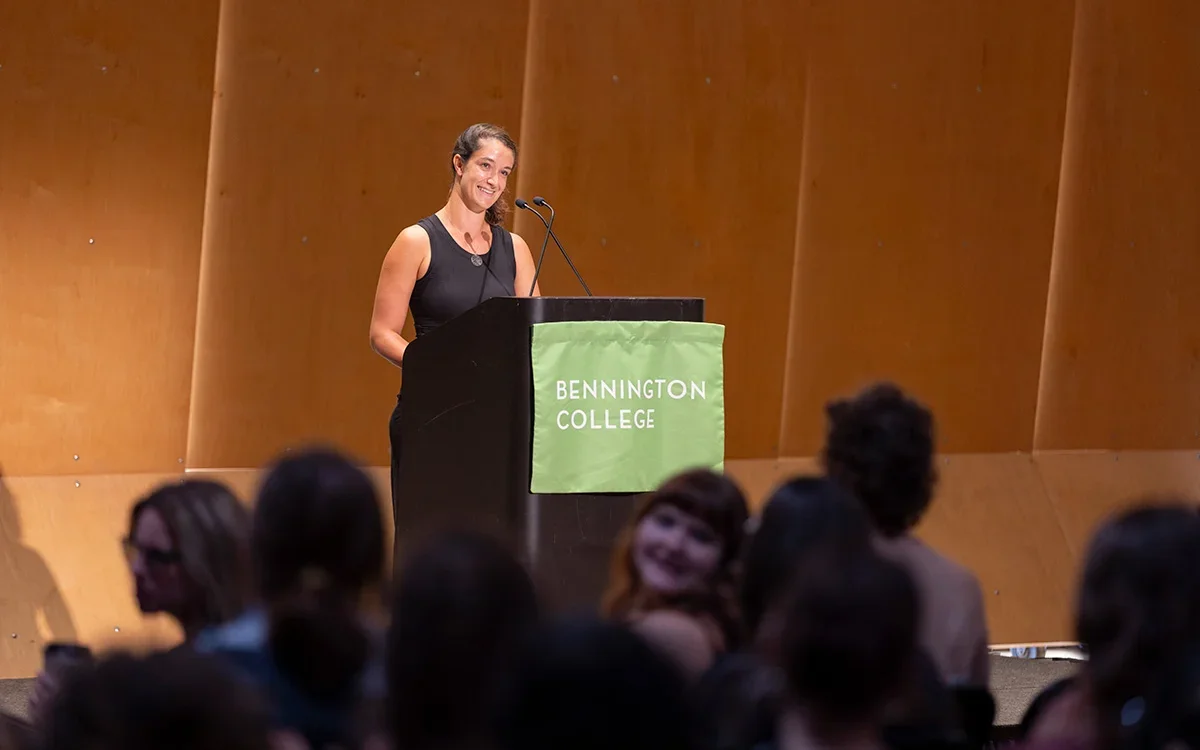
Natalie Redmond, associate writer in Communications, was the staff speaker at Convocation 2026. She shared how students may build, rebuild, and discover their sense of home at Bennington and beyond.
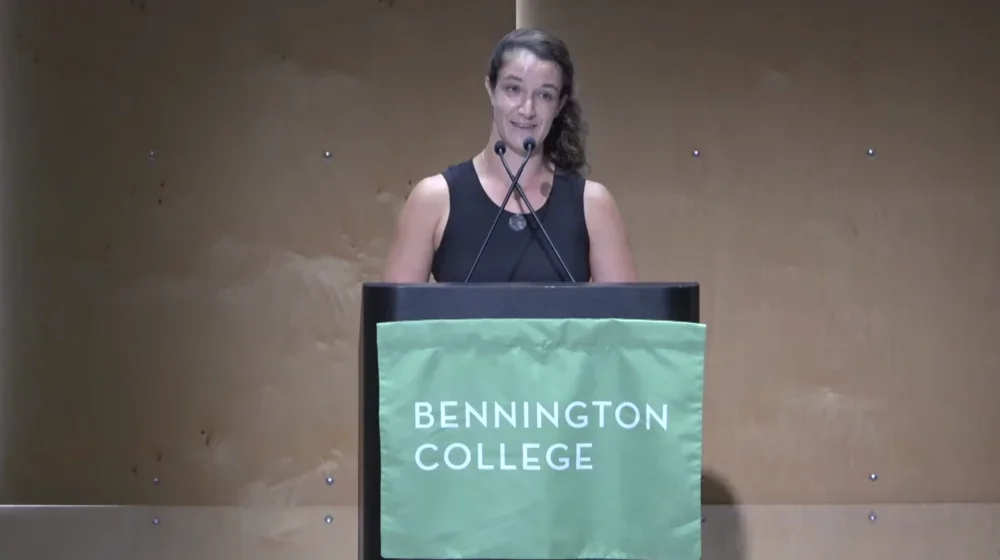

To Love the People and Places Around You
Natalie Redmond addresses the College at Convocation 2026.
Thank you so much for the warm welcome. This start-of-term energy is my favorite—it’s the beginning of a new academic year. A world of potential awaits you, and no one has homework yet! All of your failures belong to the future, baby!
To our new students—both the Class of 2030 and those of you transferring from other schools—welcome! And to the rest of us, welcome back to Bennington.
When I was invited to speak at this year’s Convocation, I was asked to organize my thoughts around how we make Bennington home.
To my surprise, my gut reaction to this prompt was sadness. Because here’s the tricky thing about the idea of home: it changes, and as you grow, it just keeps changing.
Even for the most genuinely happy people—and I’m sure they are out there somewhere—if this is your first time leaving a home you love, and people you love, to come to college, that experience, however exciting, is also a bit lonely at first.
When you do eventually return to your family of origin, over a holiday or Field Work Term, you may also find that home fits differently, like favorite shoes halfway outgrown. You simply don’t remember them chafing as much as they do now.
And while I can tell you with confidence that eventually, Bennington will grow to feel like home, even that experience will only last about four years. (Maybe a few more, if you really try to flunk things, but even that only gets you so much extra time.)
For others among you, home might be rife with challenges. Some students come to Bennington from families they are perfectly happy to leave. Some come from places where travel back is dangerous. “Home” can be a loaded concept.
For me, home has taken several iterations. I grew up, and attended college, in Michigan. My family of origin included my parents and my younger brother.
I moved to Vermont shortly after my own graduation and was hired at Bennington about a year later. During this time, I fell in love, got married, began building a new form of home. We moved to, and still live in, Greenwich, just over the New York border.
One of my pivotal shifts in defining home came about 7 years ago, on campus, in the Barn.
My brother and I had planned to talk on my lunch break, while I walked the Jennings loop. My phone rang, and I thought he was calling early. As it turned out, it was a police officer. My brother had been hit while riding his motorcycle. He did not make it.
True to my roots, I said something super Midwestern, like, “Thanks for letting me know.”
My brother was not quite 19, had been about to start his second year of college. And I was 24, newly married, and 500 miles away from my shattered parents.
I tell you this about myself not to make you sad or sympathetic, but rather to assure you that I have given much thought to this very useful question: How do you rebuild a sense of home?
I promise, it can be done, and even with great joy.
Everyone, at some point, loses “home” as they first had it. This is inevitable—it’s happening to you, even now, as you transition into college.
But you will find and create “home” again in other forms, as long as you can remember to keep loving the people and places around you.
Home, in some ways, is a bit like a Bennington Plan: it is an idea you first generate for yourself, but cannot implement without the help of your community.
Some of you may feel right at home, with a direction and an aim, almost immediately at Bennington. But others may not feel this welcome quite yet. No matter which camp you fall into, please know that it is OK. You’ll find your way as you go.
Much of the magic of college comes from simply showing up, and seeing where the next right move takes you. You can succeed at Bennington by being very driven, but you can also succeed by slowing down, exploring, showing up at campus events, trying a class that sounds cool but you have no background in, sitting somewhere new for lunch, talking to a stranger even if social interaction kind of makes your armpits sweaty.
I have now spent almost 9 years in Bennington’s Communications office, listening to students, writing stories, and promoting all of the beautiful things that go on in this strange place. My position is rooted in getting to know Bennington, helping where I can, and asking, “Where can we grow from here?”
Showing up, paying attention, and asking “where can I help?” is a great way to grow your sense of home, whether at Bennington or in your life beyond.
The other part is the people with whom you surround yourself. And by being here today, you’re already on the right path.
A Bennington education challenges you to engage with the hard questions, to ask where you can meet the world’s most urgent problems with creativity and courage.
This can be a tall order for a Tuesday morning.
It’s overwhelming, sometimes, to think about climate crises, migrant justice, authoritarian politics, war, affordable healthcare, rural hunger, and feel like you are single-handedly responsible for solving these issues, especially in the face of powerful, rich leaders who benefit from their existence.
But whatever you do, please do not despair. Instead, look around you. Your opportunities are right here.
Volunteer at a local elementary school. Support migrant workers with GANAS. Connect with other students making their family’s first leap into higher education with FLoW. Advocate for environmental reform. Give blood at our campus’s twice yearly Red Cross drive.
Let Bennington’s campus become a home that offers you space for quiet deliberation. There are people right here who need your thoughtful support, who will thrive with your friendship, who will learn from the lessons you bring them, just as much as you will from them.
As you build your Bennington home, I encourage you to remember each other’s humanity. Generosity and compassion are, in addition to being good ways to live, inherently anticapitalist. These qualities cannot be replaced by AI, bought on Amazon, or squashed out of you by the fear a 24/7 news cycle endeavors to bring.
One of my favorite writers, Anne Lamott, offers this anecdote about her priest friend Tom, and the way he copes with despair:
"He goes around his neighborhood picking up trash and dog shit. It definitely helps on days when you can't see much hope for this sweet old planet. In the long haul, grace will win out over everything, over the misery, the stupidity, the dishonesty."
From showing up, asking how you can help, and caring for each other and the world around you, even in small ways, you will find the strength to get through the day-to-day, and a way forward for yourself.
Welcome, and welcome back, to Bennington. We are thrilled you are home.