An Alumni Story: Rafe Churchill ’91
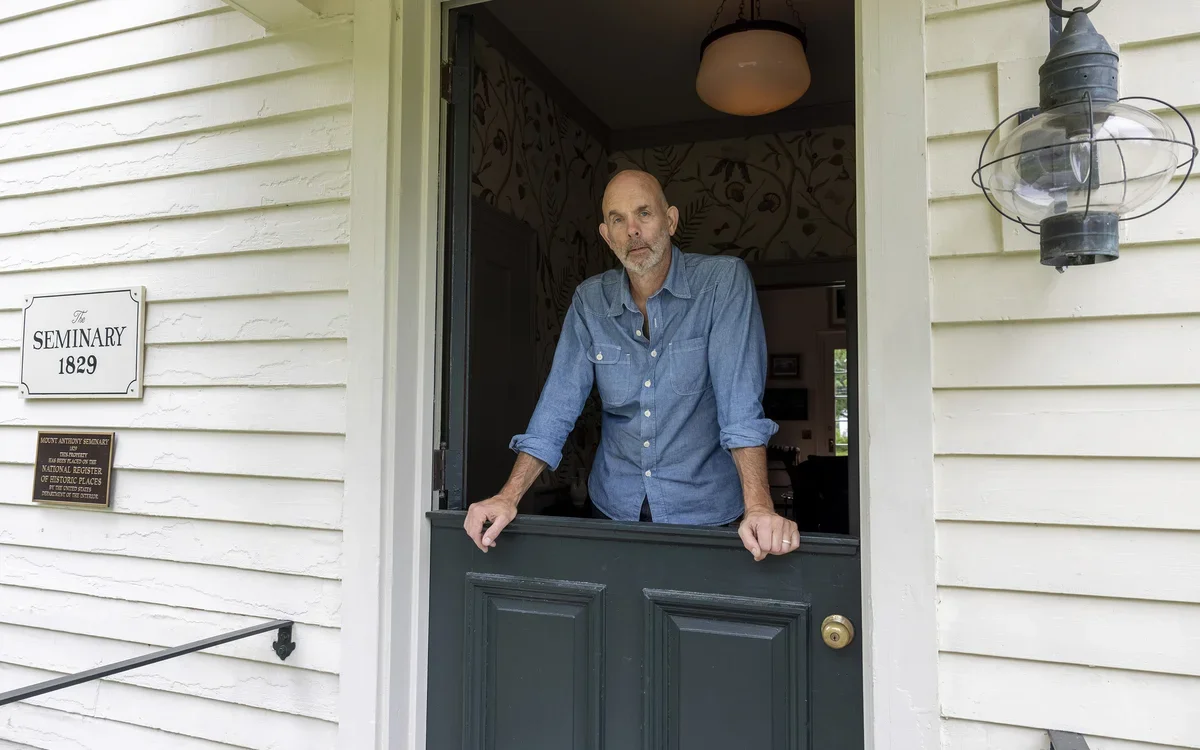
When Rafe Churchill ’91 starts talking about Bennington, people unfamiliar with the College’s all-consuming nature sometimes ask, “what is it with you and that place?”
Bennington provides students with opportunities to create a different sort of life, to combine interests, to break the rules, to learn about collaboration, to continually evolve, and to navigate their own way toward a self-defined version of success. By embracing Bennington and all it had to offer, Churchill has done just that.
Churchill, a first-generation college graduate, grew up in Woodbury, CT, a town of 2,500 people 2.5 hours south of Bennington, in a family that had been in building and construction for three generations. From childhood, he was fully immersed in construction “and all of the limitations involved with it.” But he added an interest in the arts, too.
As a high school student, Churchill took all of the art classes he could. He applied to the Rhode Island School of Design (RISD) and Bennington and was waitlisted at RISD. “I was a rebellious kid,” he said. He learned from another high school teacher that his art teacher, with whom he had “a push and pull,” discouraged RISD from accepting him and that her discouragement paradoxically increased Bennington’s interest in him. As a prospective student, he was invited to come to Bennington and stay the night.
“I immediately became friends with John Cournoyer '90, the guy who hosted me, and came away thinking, ‘I am absolutely going,’” he remembered. “I had recently turned 17.”
At Bennington, Churchill studied architecture and sculpture. He was most influenced by faculty members Patrick Beale, Sue Rees, Sidney Tillim, and their network of visiting faculty members. He brought his working-class work ethic, enjoyed the hands-on nature of the program, and thrived.
“There were guard rails, but you couldn’t see them,” he said. “It was a safe place for me. I still think of it that way.”
He became house chair of Booth and met a lot of people, including current Bennington Trustee Tracy Katsky Boomer '91 and Bennington’s current Director of Alumni Relations and Constituent Engagement Shay Totten '91, who he counts as friends to this day.
The August after he graduated, he met Heide Hendricks, his wife and creative partner, and went on to graduate school for sculpture at the Cranbrook Academy of Art in Bloomfield Hills, MI. The campus is notable for having been designed by the renowned Finnish-American architect Eliel Saarinen.
But the vibe was off, Churchill said. People were insular or not putting in much effort toward their work. “It couldn’t compare. It wasn’t Bennington,” he said. He took a leave of absence and moved to New York, where he subdivided a 5,000 square-foot loft with Roy Kortick '91 and rented out the rooms to friends from Bennington and Cranbrook. Eventually, he built a 30-person construction firm with his brother. Churchill Brothers grew quickly and proved to be a financial success.
As his career continued on successfully, he found himself dissatisfied. Once again, the vibe was off. “We were doing great work and making money, but it wasn’t who I was supposed to be… getting up, running a construction business.”
Despite not being a licensed architect, he started designing houses for clients and getting his designs published. He left the construction company he owned with his brother and designed houses full time, while Hendricks ran her own interior design business.
In the meantime, Churchill and Hendricks had two children, Hollis and Rufus. With a childhood peppered with museum visits and surrounded by artists, they gravitated toward visual arts. Despite encouraging the kids to attend any school they wanted, both ended up at Bennington studying visual art, in addition to architecture for Hollis and music for Rufus. Rufus is a house chair of Stokes. Hollis graduated in 2025 and is now setting up a new life as an artist in Los Angeles with her partner, Nico Migdal ’25.
Once Churchill and Hendricks realized that they were working for many of the same clients, it made sense to combine the companies. Together, they formed a multidisciplinary design practice Hendricks Churchill. The fit is so natural, he said, “everyone thinks Hendricks Churchill has been around forever.” They published books of their work, including Our Way Home: Reimagining an American Farmhouse in 2023 and Distinctly American: Houses and Interiors by Hendricks Churchill in 2025, both with Rizzoli.
They had built the company to dozens of employees and received more than 100 inquiries a year when Churchill felt another urge to evolve. “About 3 years ago, I hit the wall. I couldn’t do it anymore. I couldn’t continue.” Working with clients and constantly managing employees had begun to wear on him. Following 2024 end-of-year reviews and dumbfounded that his employees weren’t satisfied with their $130K plus salaries and new 4,600 square foot studio, Rafe decided to make some changes. “Once back from the holidays, we found that our team had organized in protest. It was clear that it was time to make a big move. The next day I let nearly the entire staff go, which left only the leadership team. Today we are light on our feet, very selective, and doing our best work.”
About that time, he stumbled on the opportunity to purchase a historic building in Old Bennington: The Seminary. At different points in its history, it had been used, as its name implies, as a seminary, but also as faculty housing for Bennington College and as a part of Mount Anthony Country Club. It had historic integrity and lots of charming details, including original millwork and a bell tower. All of it was in need of renovation.
With a devotion to historic preservation, Churchill set about renovating the building for friends, family, and alumni of the College. “There is nowhere of this caliber for alumni to stay,” he said. “It is difficult to find a place where everyone is comfortable.”
Along the way, he found capable business partners, including Casey Sunderland, who had worked as a film agent in Los Angeles, and, together, they began looking for new ways to monetize their skills. “Coincidentally, we had both been big fans of How I Built This, on NPR. It’s the poor man’s MBA,” he said.
There, he heard about Ben Weprin, the founder of Graduate Hotels, a company that leverages college nostalgia to offer reasonably priced hotels in college towns. Weprin sold the brand for $210 million. Churchill and Sunderland visited Weprin in Nashville, TN, and learned many valuable lessons. Churchill recalled, “Ben generously said, ‘If anyone can do this, you can do this.'”
And so he and Sunderland began developing a sophisticated art-driven hotel model. The brand is called Place in Mind, and its focus is on preserving historic American properties and transforming them into sophisticated and delightfully idiosyncratic retreats.
Similar ventures would typically invest well over $300,000 in early brand development. Churchill and Sunderland, along with two other partners in the company, trusted their own skills and did it themselves. This is nothing new for Churchill.
“Every company I have owned, I have designed the brand myself: architecture, construction, real estate….” he said. “I don’t smoke weed. I don’t drink. I don’t go to dinner parties. This is what I do, and I am good at it.”
He appreciates the experience his partners bring, some of whom left positions at the heads of large companies to join the business. “Nobody is scared to say what they are thinking. The work is better for it,” said Churchill. “We do everything under one roof. We took our studio-based model at Hendricks Churchill and applied it to hospitality. We even take the editorial photographs. We are breaking all the rules.”
With a heartfelt devotion to Bennington, the company has hired Bennington students over Field Work Term to help renovate The Seminary. Bennington students rebuilt the bell tower over the summer of 2025. The new hospitality venue hosted its first guests, Place in Mind’s partners and spouses, on May 23. Bennington Trustees stayed the following weekend for Commencement and a board meeting. The project is also getting national media attention.
Churchill’s most ardent plea is to his fellow Bennington alumni.
“People can say Bennington has changed. It hasn’t changed. Walking around campus, half the time I think I know a kid, but it’s a kid I knew from 30 years ago,” he said. “As eccentric as it is, it’s authentic. Bennington is still beautiful.”
He admits that administrations of the past made mistakes, especially disbanding the Alumni Association, but he urges alumni to move beyond the past.
“Imagine if the alumni from the eighties and nineties were all fully committed,” he directed. “These people need to come back and volunteer. Talk about it. Wear the t-shirt. Talk about Bennington with their kids.”
Bennington has always been a place that opens possibilities. No one understands better how that tradition, one of Bennington’s few, continues for current students and for alumni who engage.