Investing in Science
Grant funds new equipment.
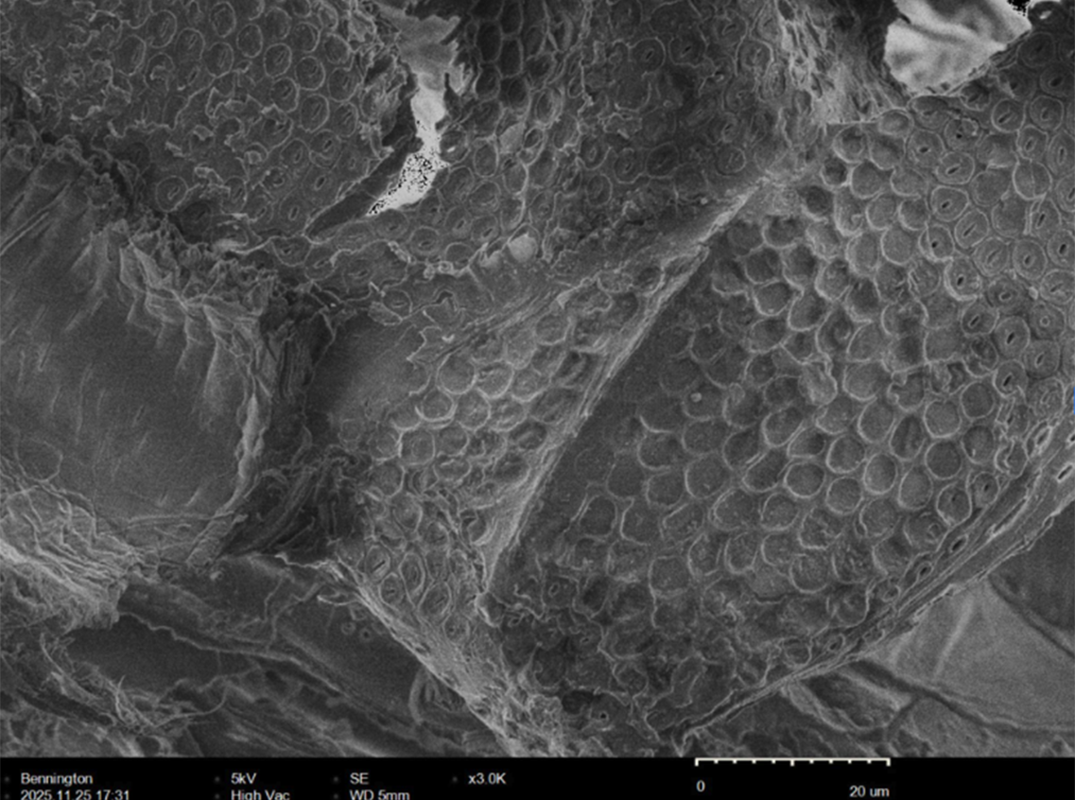
Last term, Bennington College welcomed several new instructors to its science classrooms: a Scanning Electron Microscope (SEM), a Gas Chromatography Mass Spectrometer (GC/MS), an Open Flow Respirometer System, Fast Protein Liquid Chromatography, and more.
With support from a $10 million National Science Foundation grant to enhance research infrastructure in Southern Vermont, Bennington College purchased $400,000 of new analytical equipment to advance individual faculty scholarship, to enrich research activities on campus, and to better prepare students for careers in science.
“It is more important than ever that Bennington College invests in science. This science matters to our students, to our Vermont community, and in building a more survivable future,” said Associate Director of CAPA David Bond, who secured the funding.
This past fall term, Geology faculty member Tim Schroeder taught a class on Scanning Electron Microscope (SEM) methods that introduced the device in a very Bennington way: he asked everyone enrolled to bring something they wanted to spend a term examining at over 20,000x magnification.
With meteorite shreds, scraps from black ash basket-making, burnt sugar, wool threads, and a sliver of an ocean-bottom mountain range, students spent the term zooming in on their own interests, and then zooming in even more. In the process, they became conversant with the SEM. (Encouragement for VA students to bring a piece of their own art for such close-range inspection has so far gone unheeded.)
With the ability to map and estimate elements in any sample, the SEM gave students a hands-on experience with something many had only abstractly studied.
“With the SEM, I learned how to identify elements and minerals,” said geology student Alejandra Vouga ’26. “I could finally understand what I had been reading about in textbooks for the past four years.”
Liliana VonFrank '28 was surprised to find structures resembling nanotubes in her sample of burnt table sugar.
“Anyone who has studied materials science knows that carbon nanotubes are important. They are insanely strong,” she said. “It’s interesting to find a structure this ordered in a sample that is so chaotic.”
Students presented their SEM research at Science Workshop on February 20, with many students in attendance asking when they would get their chance to play with the SEM under Schroeder’s guidance.
Such training on tech is a prerequisite for any career in science, Schroeder noted. “To be a working scientist, you need to know how to use sophisticated analytical equipment. Spending a semester working on the SEM provided our students with that unique opportunity.”
Faculty members Blake Jones, Caitlin MacKenzie, Amie McClellan, and Fortune Ononiwu also received new analytical equipment in their laboratories as part of this grant. Each plans to teach new courses that will place new equipment centerstage in their classroom.
From a GC/MS to egg incubators, this new equipment also aims to address statewide concerns over what sustainable agriculture looks like with regional PFAS contamination, economic decline, and a deluge of climate-related disasters.
The NSF grant also funded six students’ Field Work Term experiences this winter and new staff support for research and provided seed funding to four faculty members to jumpstart new ambitious research projects this year.