Making Footholds for Each Other
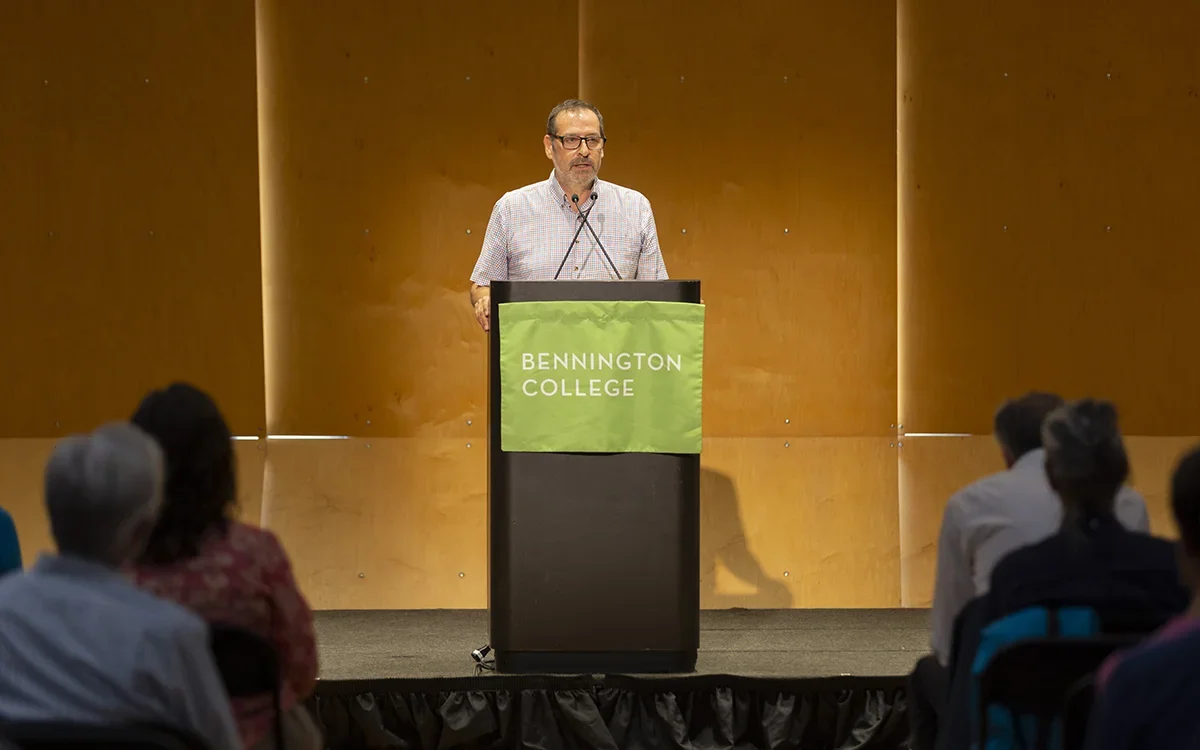
Levi Gonzales, faculty member in Dance, was the faculty speaker at Convocation 2026. She shared how students may build, rebuild, and discover their sense of home at Bennington and beyond.

Making Footholds for Each Other
Levi Gonzales addresses the College at Convocation 2026.
I am honored to have been invited to address the incoming class of 2030, our new transfer students and returning students, as well as my faculty and staff peers and colleagues, and the entire vibrant Bennington College community.
I’d like to start with something non-verbal…
(movement score - approximately one minute)
So, what was that? Well, aside from addressing my deep-seated fear of public speaking through something I am much more comfortable with, dancing, I wanted to demonstrate rather than explain what it means to be with the unfamiliar and the not-yet-known.
Let me share with you the instructions, or “score” in dance terms, of what I just did.
- Turn away from the podium and notice the space behind you. Identify a location in that space and stand in it.
- Turn to face the room and take it in with all of your senses without focusing on any one particular detail.
- Move back towards the podium in a way that would not be described as “walking”.
- When you arrive at the podium, relate to the microphone in a way that would not be described as “speaking”.
- Allow whatever you are doing to settle into stillness. Pause. Look out and see the people in the room. Maybe smile if you are feeling it. End of score.
This improvisational structure mirrors my understanding of a meaningful education, and in particular, what I have experienced as a Bennington education: engaging with the unknown, embracing the possibility of failure, and giving yourself enough grace to be OK with not being an expert at something but going it anyways. To learn by doing.
This skillset is especially important today, as we face a precarious economy and job market, massive global conflict and violence, radical political division, a volatile and increasingly uninhabitable natural environment, and the rise of authoritarianism not just here in the US but across the world. I don’t think I can understate how frightening the current state of the world is, nor how difficult it is to remain optimistic in the face of it. I know that I struggle with this daily, and I can’t imagine what it is like for young people beginning to consider how you want to move into your adult lives.
Not surprisingly, higher education has become a target by those currently in power precisely because it does provide a space for resistance. Here is where fresh alternatives are dreamt up, thought through, tried out and carried into the future. Here is where we can resist the conception of our lives as algorithms or units of monetizable online behavior, or as neatly categorizable monocultures.
But resisting takes practice. In our current environment of information and opinion overload, an era that social media scholar danah boyd identifies as characterized by “context collapse” - there is not a lot of room to develop this practice. Critical thinking requires time and space that is not often provided by the news alerts you’ve subscribed to from your political platform of choice, or the tik tok dance meme, or the pharmaceutical ads, or the insta of dogs being adorable. In order to develop this practice we need to be challenged, to be in dialogue with different points of view, and most of all we need to be able to step outside of the constant mandate for productivity and efficiency and just PAUSE.
Now is a good time to remind you, and myself, that this moment is actually happening. Even though I’ve written these words out in advance, nothing will replace this moment, the quality of light, this grouping of people, our breath, our bodies in this room, at this time of day, in this place. This is not abstract, it’s real.
Karen Gover, a previous faculty member and philosophy professor who delivered an incredible convocation speech in 2017 (which I have been trying not to compare my speech to thank you very much), observed that an education like Bennington, which is ostensibly free of traditional “requirements”, actually asks for more time and dedication and investment. It asks us to step outside of a known model of learning, and into a messy, creative vortex with an uncertain outcome.
My own life and career as a dance artist is a perfect example. While working as a professional dancer I have also been a waiter, a Pilates instructor, a teacher, a legal proofreader, an office temp worker, a data entry assistant for a New York City councilmember, an arts administrator, an arts publication editor, an artistic advisor, an activist, and often just a general screw up. I failed a lot, I changed course a lot. I leaped at opportunities when they arose, and sometimes they didn’t and I had to figure out how to make my own. I could never have predicted the path I’ve taken, the amazing people I’ve met and places I’ve been, nor that I would end up here at Bennington Vermont - a queer Chicano kid born and raised in LA and living most of my adult life in New York City. And even when I think I have landed somewhere or that I’ve achieved something solid, everything shifts and changes and I have to begin again.
I think because of this, dancing is the one thing that still makes sense to me. With dancing, things rarely go as planned. I might use a little too much force on that jump, or allow myself to lean too far off balance. I might trip or fall. The dancing might feel transcendent, or it might feel boring and uninteresting. But there is always more going on than I can ever know or explain through language or rational thought. In dancing, there is never a stable or fixed Levi, but a fluid entity in dynamic relation to the bodies and space and sounds swirling around me. I am always making choices, but I am not in control. I am a participant in something bigger and infinitely more interesting than I could ever conjure on my own. Bennington is also like that.
Now, I’m going to assume that not all of you are coming here with a deep background in experimental improvisational postmodern dance, though shout out to those of you who are! But I suspect most of you have had some experience with dancing at a wedding, in a club, at a church gathering, or in your bedroom alone… dancing creates a space for us to move beyond stiff categories of identity and social norms. It’s not efficient оr even productive, at least in the typical capitalist understanding of the term. In dancing we can create a more sensual, inclusive and pleasure-oriented world, and return to our everyday lives a little bit changed.
A few summers ago I did a performance in a repurposed firehouse in the Mojave Desert near Joshua Tree National Park. We opened the garage doors so that the audience would have a view of the massive expanse of desert landscape behind us as a backdrop. At some point we began to vocalize, and then, dimly, off in the distance we heard the answering howls of a pack of coyotes. The audience heard them too. Suddenly our dance was bigger, involving our more than human friends and the desert itself. That sensual and inclusive world was there, and I felt held and changed by it.
Bennington is, by most college standards, a relatively small place. It’s possible to keep it local here, to notice details, and to remember faces and places. It’s a place where we leave a mark and alter our environment just by our very presence, much like I experienced with the coyotes in the desert. It’s difficult to disappear here.
For all of you new arrivals, this lack of anonymity may seem like a frightening prospect, but in my experience (both as a professor and as an observer of students over time) the halls of VAPA, the pond, Jennings, the Dean Carriage Barn, Dickinson, the Commons, the Purple Carrot Farm, the end of the world and the inky darkness and deep quiet that settles over the campus at night in the winter have become the setting for a rich canvas of experiences - friendships, art, parties, achievements and revelations, lonely wanderings, empty time. This place will make an imprint on you but you will also make an imprint on it.
If nature and ecology teach us anything, it is that diversity is a necessary component of survival. In fact, it is always operating whether we want it to or not. Every year that I’ve taught here has been completely different from the one before, with a new set of personalities, rhythms and shared obsessions. It is not anonymous or neutral. It shifts, changes, and surprises from one year to the next. Who you are and who you become matters and shapes the fabric of our collective experience here.
I’d like to include the voice of a student here: last year’s student commencement speaker Andy Farrell, whose deeply insightful words captured some important aspects of this place from their perspective: “Living in a small community means being held, sometimes more closely than you would choose. But it also means that when you falter you rarely fall alone because there is usually a hand already reaching for you. When you take a risky leap into something new everyone watches with baited breath and a way deep down hope for you to land it well. That is the strange demanding gift of being known. You are accountable to other people’s memories of you, and you are protected by them also.” Damn.
*None of us know who we will be in the coming years. That is what keeps life interesting and worth living. Rather than trying to define and polish our respective brands, let’s think of Bennington as a laboratory to experiment with inefficient and complicated questions. Rather than leaving with a checklist of academic qualifications, let’s consider how to make new space for foundational human experiences such as transformation, joy, suffering, and creation.
Along with the recent passing of other inspiring figures (thinking of you Dolly), a few weeks ago we lost a singular dancer, writer and improviser, Simone Forti, at the age of 91. She gave us many gifts on the wisdom of a life lived through the body. One of her iconic dance works, Huddle, consisted of a series of instructions for a group of people to climb over one another without affect. It exemplified a way of being with people and with place through simple physical acts of trying and doing.
In 2023 Forti was awarded the Golden Lion Prize at the Venice Biennale Danza, which she decided to accept not as an individual but as a representative of the dance community that had sustained her throughout her life. As part of her acceptance of the award she wrote a small poem that included the line: “We live to make footholds for each other.” This is literally what happens in Huddle, but it also describes what can happen when we come together to build on each other’s knowledge, not in an idealized or sentimental way, but through the hard daily and time-intensive labor of thoughtfully placing one foot after another, of figuring out the best way forward, and of creating opportunities to move with one another in all our difference and glorious lack of expertise.
Let’s make footholds for each other, as best we can, here and now, and see where it takes us. And let’s maybe also dance with coyotes.