Senior Story: August Schnell ’26
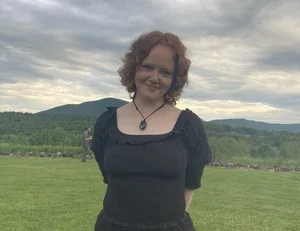
August Schnell ’26, from Minnesota, was attracted to Bennington for the ability to work across disciplines, specifically Public Health and Environmental Science. They ended up doing deep longterm work on the environmental contaminant PFAS and opening themselves up to intersecting studies in Political Science and Data Science.
Think back to yourself as a high school student. What were you like then?
I was looking for an institution where I could study public health, specifically in an environmental context. I was looking for a place where I could gain the necessary skills to do that. I wanted to study politics and environmental science, as well as other topics and to gain a broad understanding. I intend to go to graduate school, so I wanted to have a foundation for all of the various aspects of public health.
So you knew back then that that was what you wanted to study, and you stuck with it. Where did your understanding of yourself at that point come from?
Yeah. It’s something I am passionate about. It’s a combination of my love for the environment and my love for people. I want to make things better, and this is a way of making the environment better and making people healthier.
How did you find Bennington?
I had a college counselor who recommended Bennington to me. I think they had a student in a previous year who looked at it, and they recommended it to me based on that. They explained how the housing worked and the resources available on campus. I was looking at various institutions, and Bennington stood out.
What was the first day like?
It was immediately pretty welcoming. The staff were welcoming, and the House Chairs were welcoming. It’s a very queer space. That wasn’t something I was accustomed to, but I am also queer, so that was nice when entering into a new space. There was a lot of support entering into this new space with staff being there and the orientation process.
Who has been most influential in your studies?
[Faculty members] Tim Schroeder and John Hultgren have been two people who have shaped my studies. On the environmental science side with Tim, I have been able to work on the PFAS project with him, analyzing PFAS contamination in Bennington. A different project, also about PFAS, ended up including John Hultgren. I wrote an essay about PFAS in Minnesota because that was where it was invented. That was my thesis. Working with John Hultgren was really nice. I got a good bit of political background with him as well. And all of the classes I have taken with both of them have been… I have learned a lot in those courses and had really interesting discussions in those courses.
"It has been nice to, through the tutorial process, explore something in depth and gain practical experience. I wasn’t just learning about it, but also doing it."
Tell me more about your thesis.
I did my senior work in Society, Culture, and Thought. My senior thesis was about 50 pages on the environmental impacts of PFAS and the history, litigation, and made policy prescriptions. That was what my Plan was focused on: Environmental Studies, Political Science, and as a supporting area of study, Data Science. I was able to incorporate both of my topline areas of interest in my advanced work. I have also been taking a course where I have been supporting other students in data analysis, and that’s helpful because they are also working on the PFAS issue. Being able to look at this broad topic of an environmental contaminant, to be able to talk about all of the different angles: how it is spreading, what policies make it so it can happen….
What is most memorable about studying here?
The ability to explore what I wanted. In a lot of the courses that I took, the politics courses, I have applied politics to an environmental issue. I took a class in ethnic conflict, and I was able to look at the role that water plays in starting and fueling conflicts. I have been able to approach this topic of environmental science from all different angles, and I have been able to intertwine it, so it is a throughline in a lot of papers I have written. Getting to hear how other students approach things and see how they write, see how they communicate their ideas, has been lovely and beneficial to my own writing and my own thinking processes. Being surrounded by people who are interested in what they are doing and have various ways of approaching that and who are clearly passionate has been a wonderful part of learning here.
What’s next for you?
My initial plan was to take one gap year and then pursue my master’s in Public Health. It is probably going to be more gap years because there are a lot of questions right now around funding graduate school programs, especially in public health and environment science fields. I am planning to wait to see how things shake out. But I plan to continue working in various aspects of politics or environmental studies. Using connections I made through Field Work Term and my Endeavor Fellowship, I am connecting with those people for jobs, even for short term positions.
How do you imagine your life would be different without Bennington?
Compared to the other schools that I looked at, Bennington was unique in its Plan process. My studies would have been approached differently. I am not sure if I would have delved as deep into Data Science if I had not come to Bennington, and I am glad that I went into Data Science. I think that would have been missing from other programs. Experimenting with Data Science isn’t something I would have pushed myself to do. A lot of my faculty members here pushed me to do Data Science. I wasn’t planning to do that when I came. And I am grateful that I was able to work on these longer term projects. I have been working on the PFAS project for 2 years now, and it has been nice to, through the tutorial process, explore something in depth and gain practical experience. I wasn’t just learning about it, but also doing it.