Teresa Booth Brown ’85: Practicing Possibility
Teresa Booth Brown ’85 calls herself a Possibilitist. It’s a way of thinking and working that begins with simple but expansive questions: What can this be? What can we do with what we have right here? What’s the potential of this or that? That orientation toward openness has shaped her life as an artist and educator since she “ran away” to Bennington.
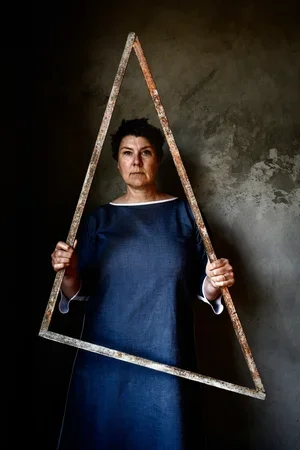
“At Bennington, everything aligned: dance, painting, sculpture, biology,” Brown recalled in an interview. “Teachers like Alvin Fineman and Pat Adams modeled a philosophy: you teach people by letting them learn.” That permission to explore, to combine disciplines, and to trust curiosity became foundational to her practice.
Brown has built a career as an artist creating paintings, collages, and clothing. Her work—which combines oil painting with collage along with mixed-media drawings and printmaking—is distinguished by strong color, abstracted imagery, and architectural geometry. She has received numerous awards, residencies, and solo exhibitions, and her work is held in collections across the country. She is represented by Michael Warren Contemporary Gallery in Denver and Skye Gallery in Aspen.
Brown takes as much pleasure in teaching as in creating. In fact, to her, the two are intertwined. She has authored professional development courses for art teachers highlighting “Teaching as Part of an Artistic Practice.” She models her teaching after the teaching she received at Bennington. “The focus of my life is to bring progressive education to the teaching of art. Students best learn by doing,” said Brown.
One of her greatest pleasures is teaching in environments where choice is limited. From youth detention centers to the Pitkin County Jail, where she taught from 2017 to 2025, Brown has worked with incarcerated youth and adults using restricted materials. “In these spaces, making art becomes an act of agency,” Brown said. She recalls a moment when a student, enlightened through artmaking, said, “This is going to be important in my life.”
Among her notable projects is The Neo-Quietism Project, which explores the meditative and restorative potential of making and looking at abstract art. Booth Brown says that language or others’ expectations sometimes get in the way of viewing and making art. The project aims to give viewers and art makers permission to experience the work for themselves.
Until recently, Brown was the Director of Education and Community Programs at the Aspen Art Museum, where she expanded access to creative experiences, including programs that brought hands-on artmaking to thousands of children each year. She now is striking out as an independent traveling educator and is writing two books: one on mentoring artists and another on teaching creativity to children. “I like to help people discover their own ways of being and support each person in identifying and developing a direction that is uniquely their own,” she said. “If you can hold a pencil, you can draw.”
For Teresa Booth Brown, possibility is not an abstract idea. It’s a daily practice—one learned at Bennington, carried into the studio, and shared wherever art can open a door.