From Transfer to Playwright: Rachel McCauley ’25 on Finding Voice and Vision at Bennington
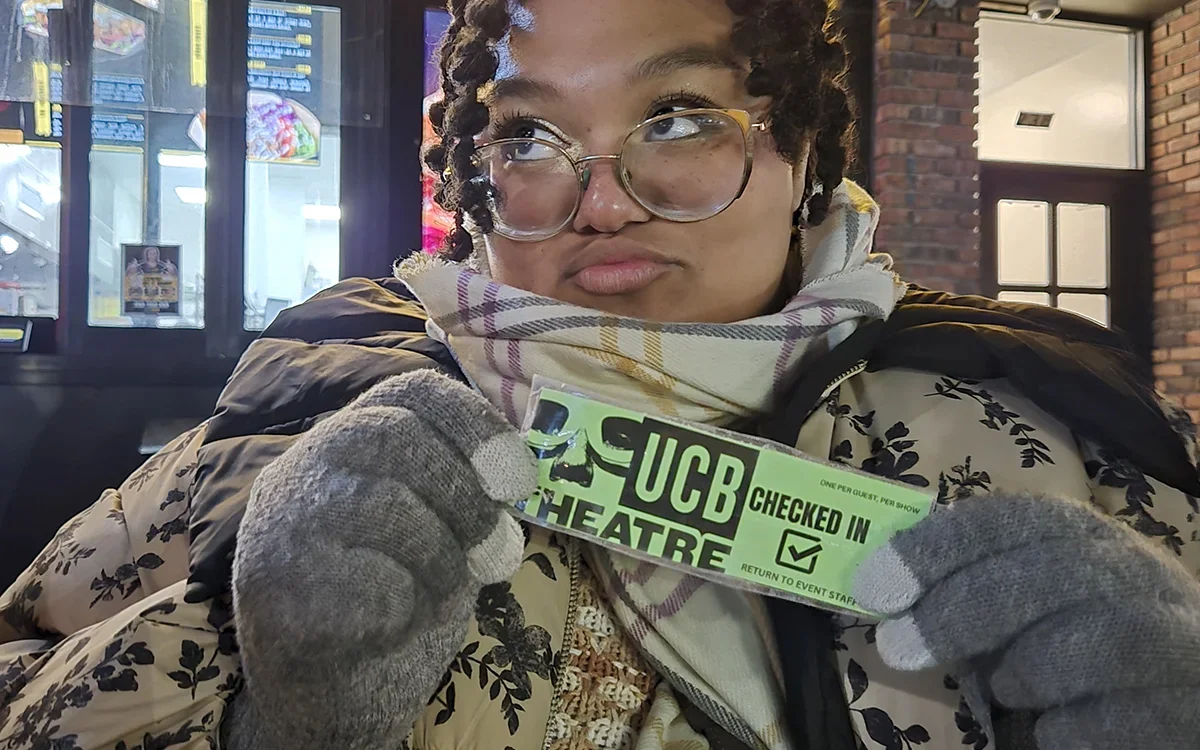
Learn about transfer student experiences at Bennington College.
Rachel McCauley ’25 transferred to Bennington after realizing that the college she originally attended—a small liberal arts school in Virginia—wasn’t the right environment. “Pretty quickly, I realized it wasn’t for me,” she said. “The area has a racist past, and the school itself felt institutionally racist. I needed somewhere with fewer issues like that.”
She’d first come across Bennington in high school, mainly because of famous Bennington College alum Peter Dinklage ’91. "I remember looking Bennington up, but I didn’t pursue it seriously at the time,” said McCauley. It was her mom who encouraged her to take another look during winter break. “I looked at the housing. Students lived in what looked like actual houses, not concrete boxes. It felt different.”
Bennington became her only transfer application. “I was low-income and was looking for schools that didn’t have an SAT requirement. I had to get all the paperwork and financial aid together. It was nerve-wracking. But I got in.”
“When I toured, I knew it was the right college. The tour guide was super nice and a person of color. They were really positive.”
McCauley arrived early for orientation, alongside international students. “They didn’t hesitate to include me. They made me feel welcome.” But that time wasn’t without its initial challenges. “Transferring is hard. My credits didn’t transfer until late, so I ended up in First-Year Forum for a term. A lot of people thought I was a first year. Socially, there were still friendship pods—people who were really tight—but the environment was more open.”
“The first term was actually pretty smooth. I made new friends, went to parties, got involved. People were welcoming—staff, house chairs, orientation leaders. It made a big difference. Later on, I connected with other transfer students who came in after me. That connection felt important.”
What ultimately drew McCauley to Bennington was its academic structure. “I was really drawn to the student-led structure. I wanted to focus on a specific set of skills and to build something interdisciplinary. ‘Regular schmegular’ can be good: Acting 101, 102, Anthropology 101, 102. But I wanted more classes that were broad and interdisciplinary. I got to a point where I was developing things that nobody can do but me. I think the people who do best at Bennington are the ones who understand what they’re doing and why. Bennington seemed like a place where I could work toward that. It’s an incredible structure to live under.”
That interdisciplinary approach came full circle in her senior work: A Boy Named Salmon, a full-length play she wrote, directed, and in May 2025, presented in Margot Tenney Theater.
“At its core, the play is about intersectionality,” she said. “It’s about being in white spaces, especially ones that call themselves liberal, and realizing how superficial that so-called progressivism can be.”
The story follows Salmon, a white teenager who learns his great-grandmother was Indigenous and was forced into a residential school. The discovery throws him into a space familiar to many urban Native people—caught between what is inherited and what is lived.
“Salmon has to deal with the kind of struggle of, ‘Am I or aren't I?’” she said. “I wanted to ask questions about what makes a person Indigenous, and who gets to say so?”
She credits Platforms, a course that supports student-led theatrical work, with making the production possible. “Platforms was a lifeline,” she said. “It made it possible for me to tell this story.”
Despite limited resources and some self-doubt, the production was deeply rewarding. “It was so hard, but so worth it,” McCauley reflected. “This was my first full play, my senior work. It’s a reflection of who I am and what I believe in.”
Graduation brought a mix of relief and reflection. “A two-hour ceremony, five steps to get your diploma, and then you’re done. For three weeks after graduating, all I did was sleep.” But she didn’t stay still for long. McCauley moved in with her aunt in the Bronx, worked two or three part-time jobs, and saved money. “I decided to commit to the bit. This is what I wanted. So I moved to Harlem.” She has two roommates and works as a caretaker for a family, which gives her enough money to live on and time to write plays.
Shortly after moving, she landed a remote writers residency with Mouths of Babes Theater in Wilmington, NC, a company known for documentary-style, research-based plays. “I applied for a writers residency... and I got it. So I am working remotely on a research-based play. We just assembled a list of people to interview. It’s crazy how fast it happened. It feels pretty good to be right out of school doing a writers residency. Bennington helped me get to that place.”