Frost Museum Revives Historic Barn with Major Grant Support
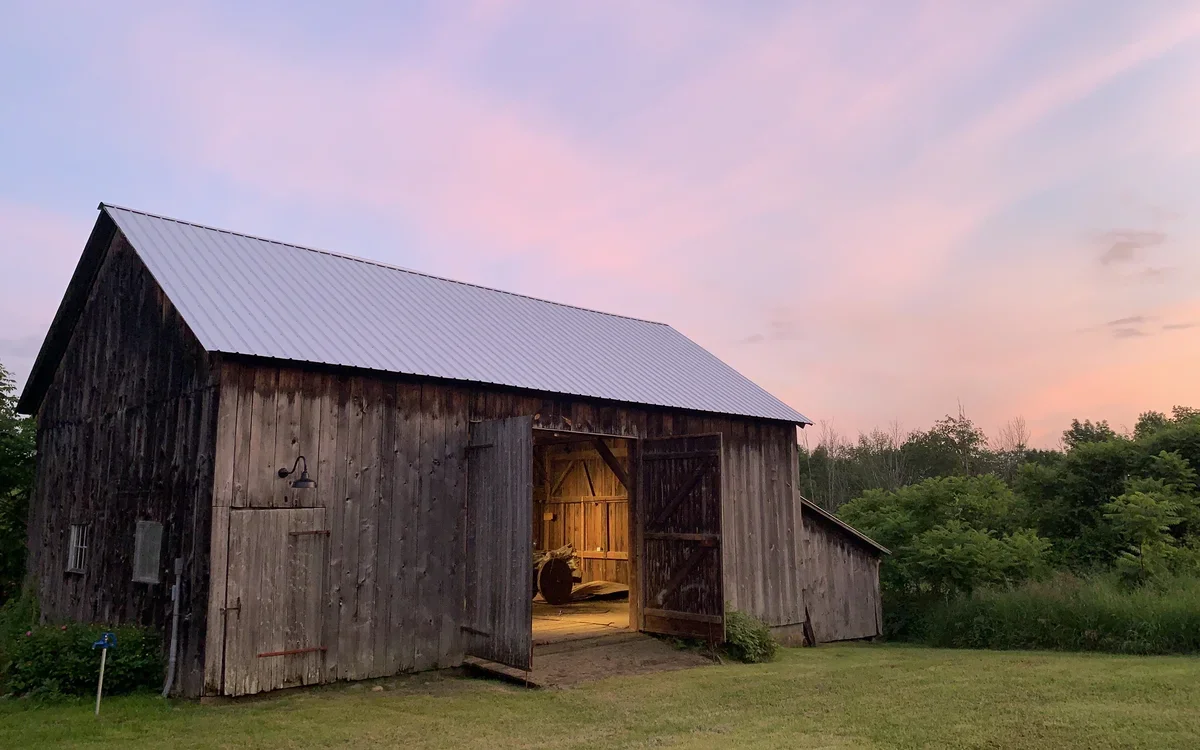
Fall events celebrate Frost's agrarian legacy and barn restoration.
The Robert Frost Stone House Museum is pleased to announce the completion of a major project as part of restoring its historic barn. The Museum received generous support from the Edwin S. Webster Foundation, a Cultural Facilities Grant from the Vermont Arts Council, a grant from the Windham Foundation, and donations in memory of Lea Newman, a local Frost biographer and friend of the Museum.
“We are so grateful for this show of commitment to the preservation of these beautiful and evocative structures,” said Robert Frost Stone House Museum Director Erin McKenny. “Through programming in the historic barn, the Museum can further explore Frost’s lifelong connection to agriculture and its relationship to his poetry and strengthen our community’s connection to creative innovation and rural traditions.”
Work included the addition of electricity and water to the 1850s historic barn and enhanced electrical and water access to the small meeting barn on the property. The funding specifically supported the excavation, plumbing, and electrical work that allows the Museum to maximize use of the small meeting barn for programming and, for the first time, the use of the historic barn, the largest indoor, open-plan space on the Museum’s property. The funding also supported the installation of directed track and fixed lights in the historic barn, directed track lighting in the small meeting barn, and outdoor lighting on the sides and entry of both barns, WiFi access, and water access to both structures. The Museum replaced the roof several years ago, which was partially funded through a Historic Preservation Barn Grant from the Vermont Agency of Commerce and Community Development. The last phase of restoration includes replacing boards and the door on the southern side and replacing boards throughout.
In celebration of updates to the Frost Museum's historic barn, the Museum is hosting several fall events including a talk with historic preservationist and timber frame expert Jan Lewandoski entitled, The Barn in Vermont; and its relationship to the history of agriculture in New England on Sunday, September 28, at 3:00 pm. Lewandoski is the owner of Restoration and Traditional Building, a company specializing in heavy timber repair and restoration of barns, churches, and wooden bridges, as well as reproduction architectural finish work for these structures. Lewandoski and his crew have been doing this work for more than 40 years, mostly in Vermont, but also nationwide and in Canada. He spent five years re-erecting a Chinese house, Yin You Tang, for the Peabody Essex Museum in Salem, MA. Lewandoski is currently restoring the lantern at the Old First Church in Old Bennington. This talk has been partially funded by the Preservation Trust of Vermont with additional support from the Windham Foundation.
The barn will also be open for touring during an Apple Cider Pressing event with Watson Wheeler Cider on Saturday, October 4, from 2:00–5:00 pm. It will be an afternoon of cider pressing, live music, apple crafts, and harvest season libations. Watson Wheeler will be offering free tastings of their hard cider, also for sale during the event, as well as free samples of fresh-pressed juice from the Museum’s apple orchard. Sage Pizza Company will be on site selling pizza.
About the Robert Frost Stone House Museum
The Robert Frost Stone House Museum at Bennington College, located in Shaftsbury, VT, is a historic homestead and community cultural resource exploring the foundational elements of Robert Frost’s life: poetry and place-based art making; agriculture and the environment; and teaching and learning.
The Stone House, built in 1769, is the site where Frost wrote, among other notable poems, “Stopping by Woods on a Snowy Evening,” “Nothing Gold Can Stay,” “Fire and Ice,” and the book New Hampshire, for which he won the first of four Pulitzer Prizes. It is also where he grew apples, planted red pine trees, had a large garden, and kept bees; it was a place of industry and creative activity.
The museum honors Frost’s creative legacy through interpretive tours and seasonal programming, which includes readings, concerts, art exhibitions, workshops, and an annual Holiday Makers’ Market.
Interested in supporting restoration and programming at the Robert Frost Stone House Museum? Become a member today