Unfolding History
Chuna Chugay'25's Graphic Novel Illuminates the Koryo-Saram Story
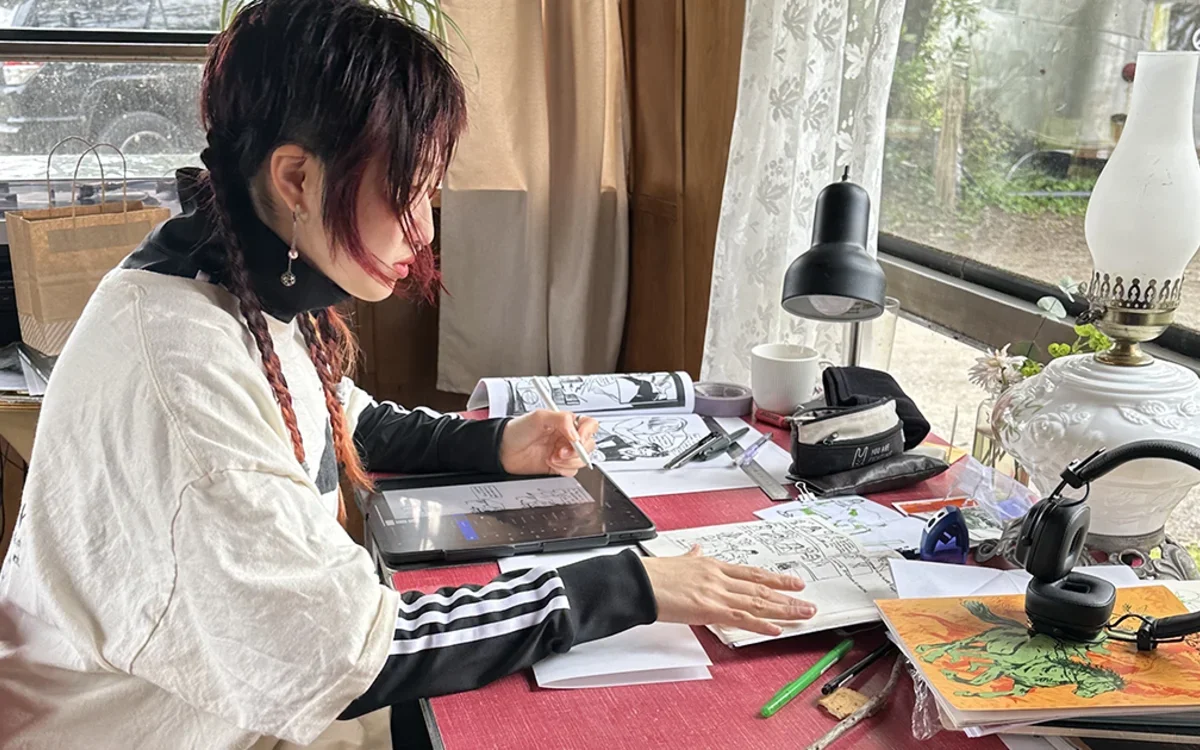
In the final year of their studies at Bennington College, painter, documentary filmmaker, and graphic novelist Chuna Chugay ’25 is working on a story that has never been told—especially not like this.
Through Bennington connections, they were one of twelve comic artists accepted to Trailer Blaze, a week-long, self-directed residency in Seaview, Washington, and daughter project of Seattle’s annual Short Run comics festival.
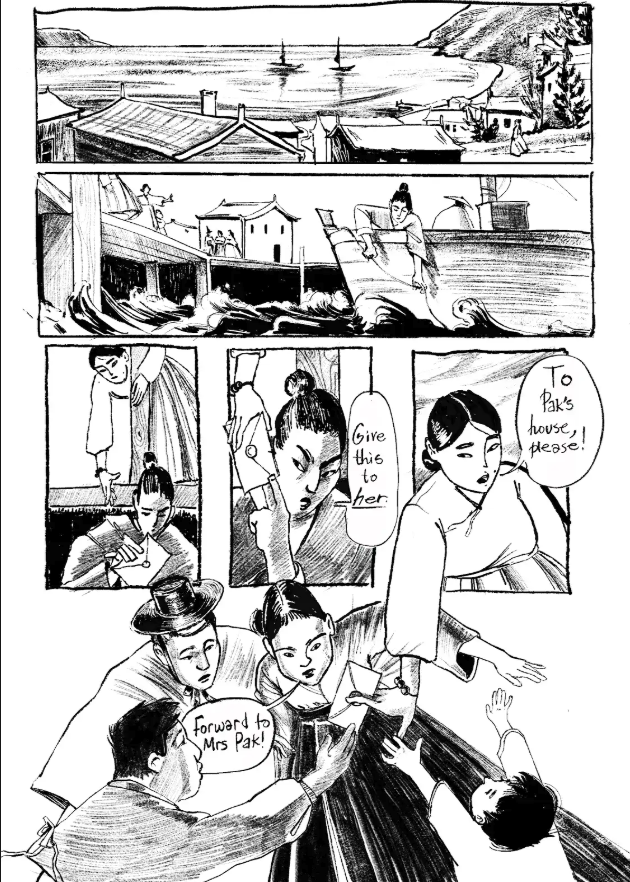
Chugay’s project—a graphic novel—draws from research they conducted as a part of Bennington’s Newman and Cox Public Action Student Fellowship. The fellowship supported their interviews with Koryo-Saram elders and survivors of the forced migration of Koryo-Saram under Stalin’s regime in 1937. The project also draws from their own life.
“I want to make this information more accessible for younger generations of Koryo-Saram, who did not have a chance to hear about this part of their history from their family members,” said Chugay.
The book unfolds in two timelines: one that tells the historical events of the deportation through the lens of a specific family and another that reflects Chugay’s own experience growing up in Russia as a person of color and a descendant of survivors.
Chugay met regularly with writer Jenny Boully, faculty member in Literature, and painter Ann Pibal, faculty member in Visual Arts, to workshop Chugay’s project. Chugay said, “It is an amazing mix and an honor to workshop this project with these faculty members.”
Boully feels similarly honored. When she received the professional introductory email along with a request for assistance with the literary aspects of the project, Boully was overwhelmed by the samples of the work.
“It wasn’t a question of whether or not I will work with them,” said Boully. “It was this tremendous feeling of, ‘Oh, my! This student wants to work with me?’ They had already accomplished so much, and just looking at the visuals as well as the very particular, unique, important story that it carries, I was just blown away.”
Pibal noted Chugay’s research and the different media they have explored during their time at Bennington, including animation, documentary filmmaking, painting, and their graphic novel. “All of the projects have intertwined visual elements,” said Pibal. “Chuna leaves Bennington with the ability to contextualize all of these projects not just within the history of the Koryo-Saram but also within art history, contemporary art, and graphic literature.”
Chugay learned about Trailer Blaze in 2023 from comic artist Julia Mata, who exhibited work at Usdan Gallery and presented a Visual Arts Lecture Series talk. “They did a studio visit with me,” Chugay explained. “Meeting someone who’s also in the graphic novel and fine arts worlds… it’s a fairly rare overlap.”
Chugay applied to the residency program and learned of their acceptance during a meeting with Boully. “Chuna was asking for advice,” remembered Boully. “‘What things should I be doing professionally?’ And I suggested, ‘Oh, how about you look into residencies?’ Just then Chuna said, ‘Wait, I just got accepted into one.’”
In April, Chugay packed up their sketchbooks and a growing collection of graphic novel pages and headed west. “It’s gorgeous, right on the coast,” Chugay said, flipping through snapshots of their stay. “You live there in vintage, refurbished trailers, and you’re given a living space and studio.”
Chugay had been delighted to meet Mata, just one artist at the intersection of fine arts and comics. Suddenly, they found themselves surrounded by a dozen comic artists of all backgrounds—from professors at top art schools to European artists.
“It was interesting to see people work who are not just learning it but who have dedicated their life to this and who are so far ahead of me in this process,” said Chugay. “Everyone was so open and excited to share their work and to see other people’s stuff.”
Days at the residency were unstructured; participants cooked their own breakfasts and lunches and gathered each evening for shared dinners that often ended late in the night with deep conversations on the porch. One of the most meaningful parts for Chugay was the studio visit sessions, where artists presented 20-minute pop-up galleries inside their trailers. The artists were encouraged to ask questions of their visitors and vice versa.
“I had questions about publishing—how to pitch, how to find an agent,” they explained. “It was the perfect time for me to go because people had great advice.”
“There is a quality to Chuna’s work that is both so mortal and tactile but also this element of mystery, fragility, and lightness,” said Boully. “How they can balance what hurts and what’s beautiful is amazing.”
Chugay exhibited the book with twenty-five complete pages alongside two large paintings and an animation/documentary project at the annual Senior Show at Usdan Gallery in May and prepared to pitch the book to agents and publishers in the weeks and months following graduation.
“There is a feeling of inevitability about Chuna’s work, their talent, work ethic, and their unwavering determination to tell this brutal and under-recognized chapter of the experience of the Korean diaspora and its multigenerational echoes,” said Pibal. “Chuna compels viewers into the story through the use of scale—both visual and narrative—and the delicate blend of the acutely personal with the broadly historical.”
“I have no doubt that Chuna will accomplish so much, as long as they continue to put pen to paper,” said Boully. “People will know this book.”