Songs from Life
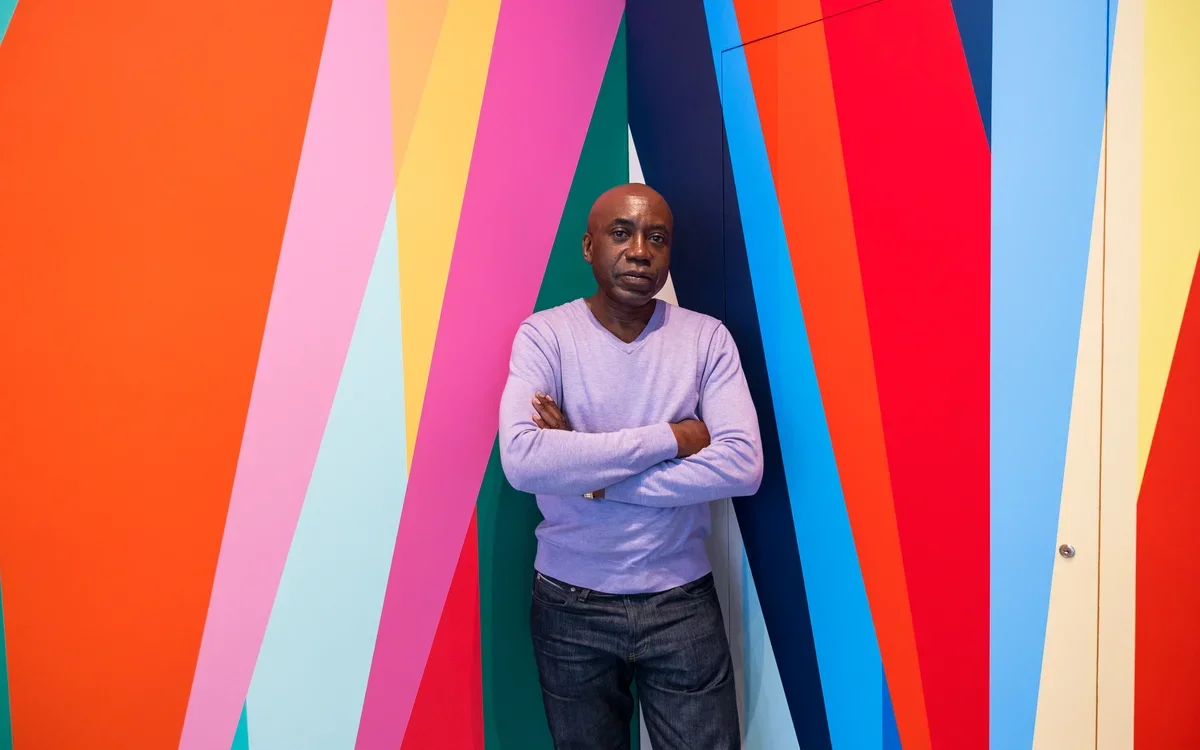
A conversation with Odili Donald Odita MFA '90.
Odili Donald Odita MFA ’90 is a Nigerian-American abstract painter. His vibrant, large-scale works combine influences from his Nigerian heritage and Western modernity and explore color through both historical and sociopolitical lenses. Odita’s art has been hailed for its powerful presence, often using complex geometries and contrasting hues to raise questions about race and society. His solo exhibition, Songs from Life, at the Museum of Modern Art (MoMA) through April 2026, is a significant milestone in his career. Odita currently serves as a professor at Temple University’s Tyler School of Art and Architecture and as a Bennington College trustee.
First of all, congratulations on the MoMA exhibition!
Thank you. I’m feeling good about it. Actually, I’m understanding it as a great accomplishment. I’ve worked at many different great institutions, but this is a pinnacle. At this time in my life, there will be more pinnacles to achieve, but this was an important one for me, and it proved a lot about what I could do with my team and with the institution.
Please describe the installation for those who haven’t seen it yet.
It encompasses the entire lobby between 53rd and 54th Streets. Throughout the install, I made different patterns and drawings to evoke aspects of the narrative. The story is essentially one of an immigrant traveler, coming to the museum or coming into the country and going through the process of integration and acclimation. There’s a certain kind of transition in this space, a terrain of difficulty, where the traveler has to come to terms with certain things and come to the other side of that.
People come to the museum for one common purpose, which is to engage art or to engage beauty, to engage an idea of enlightenment and truth. So art becomes this catalyst to draw people into the space, to engage in ideas, to share their differences on this idea of art, and to come away with multiple conclusions. Coming into a museum with a friend and looking at artwork and having a discussion, you may have different opinions or different understandings, but you can come together to a space of acceptance. It’s a reflection on the dialectic of the world and how the museum is a utopian idea of how people can potentially communicate in the world.
And at this time, where we have these difficulties, particularly because of individuals with power who want to take the worst parts of ourselves and use those to establish structures, I think the museum is a counter to that because it speaks toward the idea of freedom in expression, which is what some of these few people don’t want at all.
Tell us about your time at Bennington as a student.
When I was at Bennington, it was a lot of fun. It was a great creative space for me to work. I think about the integration of the arts. I took music classes, not as a musician but for an appreciation of music. I took Black music courses with Bill Dixon, and he brought dancers into the classrooms for us to draw from. So there’s this application of different art forms, in a way that art has been engaged in historically, not in the way that we understand it in academia, where we silo these things. But the fact is that, historically and in many cultures, these art forms were brought together.
You’re also a member of the Bennington College Board of Trustees. Where does the motivation to serve in this way come from?
I know that Bennington went through difficult times toward the end of my time and when my wife [Emanuelle Kihm ’93] was there. We met at Bennington at that time. I know the school was trying to make positive changes for itself, and they did prove to be good changes, but I think they could have been executed better. I want to represent that memory in my position.
As a board member, I want to create a welcoming space for students to come back and visit because it was a beautiful time in their lives. They grew there, and they can look to the school to give them guidance as an alum, maybe contact other alumni, maybe give a sense of connection out there in the world. I don’t think of it only as a place where people spend two years or four. I’d like it to be a place where people want to go back and want to give back. If we can create something like that, that’s going to be vital for Bennington.
Songs from Life is up at MoMA through the spring of 2026.