There’s Nothing You Can’t Learn
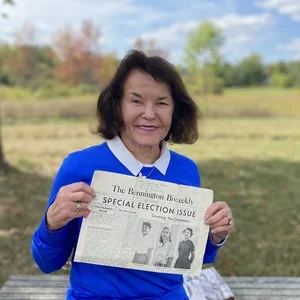
After more than seventy years, Trustee and successful business person Charlene Schwartz ’54 is still trying to bring the Bennington College magic that shaped her life to others.
What were your impressions of Bennington as a student?
When I came to Bennington, I didn't know what I wanted to learn. I was hoping that I would be up to the work. It was an all-girls college. Then, there were 350 of us in the school, and a lot of them had come from private schools, which I did not. I felt they were way ahead and better prepared for college. Coming from a public school, I felt I had a lot to catch up on.
I didn't know what to expect, but I loved the environment. Bennington has a special magic about learning. You feel like this is a wonderful place to open my mind, my heart, my life, and that was my beginning.
There were twenty-six rooms in a house, and they all had one big living room. So immediately there was a camaraderie. My classmates were from all over the United States. I was from Long Island. My roommate was from California. Many of them knew what they wanted to do. And in my case, I could only learn from these people. It was a wonderful, wonderful beginning of an academic life.
When I left Bennington, I didn't know it at the time, but as my life developed and I was in business and I had neighbors, I never met a group of such smart people in my life as those girls at Bennington. Now, individually, I've met outstanding people, but the concentration of wisdom, fun…just so many good qualities…I never found that anywhere else in a group.
I never met a group of such smart people in my life as those girls at Bennington.
How were your classes?
I was interested in politics, math, and economics, and that was not typical of the Bennington students. George Soule, an economics faculty member who was pretty well known in the outside world, was my counselor. He helped me plan my classes. Through all of his guidance, I took many wonderful classes in literature. Every year, I studied at least one dance or one art course or one of the drama classes, music, all things that Bennington had open to us as students. I had never been involved in the performing arts or in painting or artwork, so that was a new world for me.
Faculty member in painting Paul Feeley was one of my art teachers. I was the least likely candidate for an art profession. I took it because he was a formidable person. But when I graduated and I saw my grades, I had gotten a high grade from him. I went to see him, and I said, “I'm amazed. How could you have given me such a good grade?” And he said to me, “I think you came along or moved ahead further than others in the class.” Now, what a wonderful thing that is to say to someone. I knew I was the only one who probably didn't have any art aspirations or expectations, but I worked so hard, actually, I probably did make a big improvement.
Earlier in my time as a student, I had a literature teacher. I remember, one day I said to her, “I'm trying so hard. Why can't I get a good grade in this class and in any class?” She said to me, “You'll see. Once you get a good grade in one class, you'll be able to get a good grade in all the classes.” And that's what happened. I tell that to my children and my grandchildren: once you've learned how to study, how to perform, it goes for anything you do.
In my senior year, I served as president for the Executive Committee, which was like a student council.
What did you do after Bennington?
I got married after graduation. My husband was in the service, and we lived in California. So I went to UCLA for experimental psychology. That was one of the fields that was open and that I could get into, so I applied. The thinking was you could jump into any field.
You might think that studying political science and economics sounds different from studying psychology, but it was fine. I was happy with it. I think school is magical. I think it puts in your mind, number one, let me try it. And you learn to like what you learn to know.
After UCLA, I went to Columbia, where I did all the classes for the doctoral degree in experimental psychology but did not complete my dissertation. My lifetime work was running a business, and that's probably what I was most suited for. I had my own hotel business for more than forty years. I was the first female franchisee for Marriott and then the first female franchisee for Applebee's. So it's a Bennington story.
There's nothing you can't learn and nothing you can't do.
Recently you came back to campus for a week with your husband to experience classes today. What was that like?
The campus is much more international now. I don't know if we had any international students when I was at Bennington. Seventy years ago, I don't think people traveled the way they do now. And I wasn't used to seeing boys in classes. But otherwise, the students now could have been any one of my friends from seventy-one years ago: curious, questioning, dynamic. The Bennington student is still the same vital force that I remembered. I feel very comfortable there.
The Bennington student is still the same vital force that I remembered.
Why have you chosen to serve on the board?
Number one, it was a way of giving back to Bennington. It surely was a way of trying to encourage other students to come to this wonderful school. I love the whole Bennington way of thinking. I wanted to bring it to others.