Adults in the Room
The Genesis of the Bennington Center for Artificial Intelligence
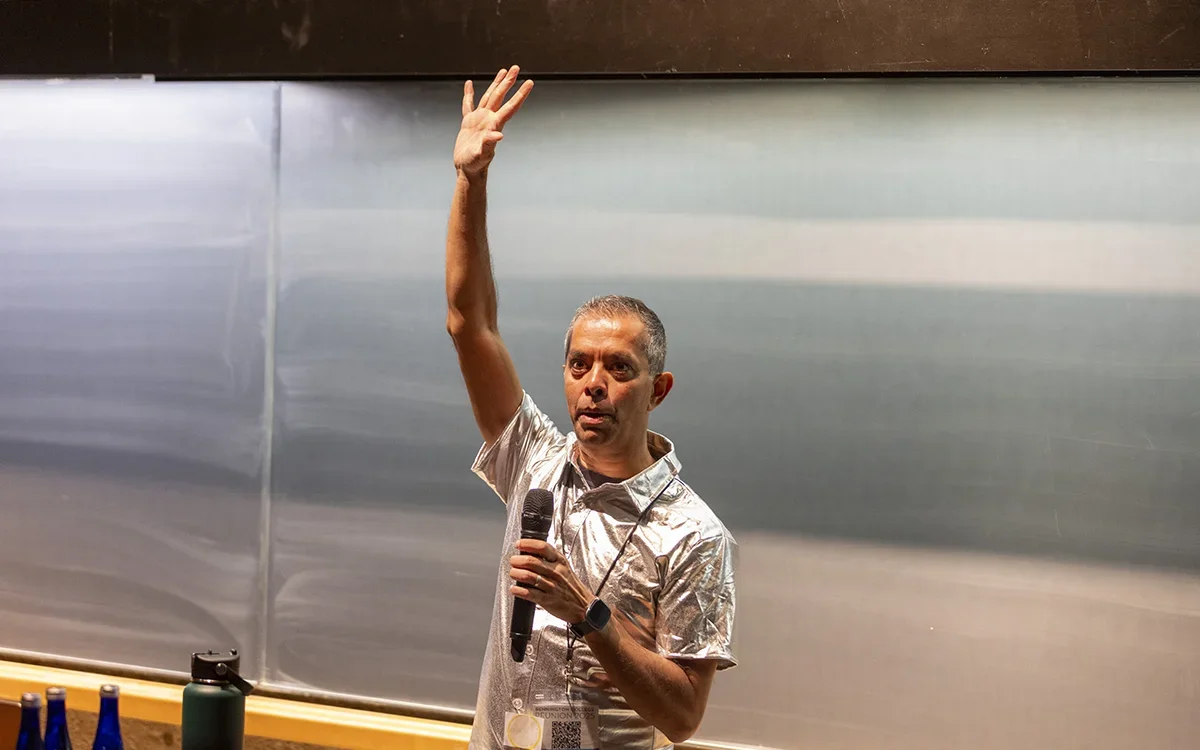
During a 45-second pause in an interview about artificial intelligence (AI), Adnan Iftekhar ’97—self-proclaimed AI Humanist with 25 years of experience at the intersections of education and technology, including with firms like Google—created and shared an audio file. It was former U.S. President Barack Obama delivering a speech.
“The American justice system has come under attack, and we need better representation,” says Obama. “Therefore, I am endorsing Adnan Iftekhar as the next representative who will change the system from within. Please give him your utmost support.”
The audio is flawless.
“If I can create that in about 45 seconds, with the tools that I have at my disposal, what can nefarious folks do?” asked Iftekhar. Using generative AI, anyone can create an audio file and even video filled with misinformation and present it as real. Scammers, who once relied on grandparents not recognizing the sound of their grandchild’s voice, can now spoof the voice. Those are far from the only risks.
The Risks
Environmentally minded Bennington students are upset about the natural resources being used to power AI data centers, which are sometimes said to need vast amounts of energy, water, and rare minerals and to create technological waste. Other concerns include AI companies placing data centers in economically depressed regions, whose residents are least capable of fighting the pollution and water scarcity they may cause. However, AI advocates claim that the environmental impact has been exaggerated.
Economically minded people worry that AI will replace workers and lead to vast unemployment. They worry that the investment bubble AI is causing will lead to volatility in the stock market and serious economic upheaval. Many experts claim that AI founders are overinflating how close they are to achieving general artificial intelligence in order to raise outsized investments in the technology.
People are worried about generative AI using words, images, and even music from genuine works of art to create new works without compensating the original artists, writers, and musicians. “AI slop”—quickly produced, low quality content—is already choking the Internet, while human artists struggle. And, because AIs are trained on human-produced content, there is a risk of perpetuating harmful biases.
On top of that, real functional human relationships are being replaced by AI companions, who, it should be said, cannot loan you a cup of sugar or feed your cat when you’re on vacation. At least not yet.
“The way that it's being used right now is pretty harmful in a wide variety of ways: to artists, workers, and then to the environment,” said Andy Farrell ’26, who studies AI and ethics at Bennington. “Communities are being actively harmed by where they place data centers. It is a big social issue, the way it's currently being used.”
From an academic perspective, faculty members are worried about students using AI to farm out their thinking. Small classes and the expectation of participation make learning at Bennington less fakable than at many other colleges, but a great classroom experience alone doesn't solve the problem. Faculty members still rely on essays and reports to challenge students and assess their progress.
“AI has knocked the pins out from under some of the traditional evaluation methods,” said Darcy Otto, Bennington College faculty member in Computer Science. “It's removed the ability to assign some tasks because you can't guarantee the integrity of those assignments. If students are using AI and not writing and thinking for themselves, they are not learning.”
Adnan Iftekhar is convinced that the negative aspects of AI are inevitable. “I tend to be a lot more optimistic than other folks, but I do think that there are a lot of dangers ahead,” he said. “The speed at which China, the United Arab Emirates, France, Albania, and the U.S. are going… it's just a race. And none of this is being done, except maybe in China, with government control. So it's almost useless to talk about the dangers, because the dangers are there and can no longer be avoided. The point of no return has already been reached.”
Alumni, Faculty Members, and Students in the Action
Farrell is uneasy about the corporate-, profit-driven path AI has taken but is also convinced that certain types of AI can do good, especially in the medical field. In 2024 and 2025, Bennington students have worked with Southwestern Vermont Health Care as a part of Field Work Term. One group created an AI program to predict when patients would need a follow up visit. Medical professionals could use the prediction to provide more attention and care during an initial visit, so the patient wouldn’t need to come in again. That could improve care and decrease medical costs.
Agentic AI completes rudimentary tasks, like summarizing emails and suggesting responses. Many, including Iftekhar, are excited by the ways that AI will provide us with more time for human interaction and connection. He and others, including Jacob Bielecki ’09, have built businesses to consult companies and nonprofit organizations about how to optimize their operations with AI.
“At a typical desk job, you're spending 70 percent of your time in front of a screen and 30 percent of your time with humans: clients, colleagues, and customers,” said Iftekhar. “I want to switch those numbers around so you're only spending 30 percent of your time in front of a screen and 70 percent of your time with colleagues and customers, and hopefully, also with your family and friends.”
Bielecki founded beneAI in 2025. He helps resource-sensitive nonprofit organizations use AI to improve operations ethically. He has also helped foundations implement AI solutions to automate the intake of grant applications, which have increased dramatically with the use of AI.
“Nonprofit leaders want to use their brains, get more out of what they have, and realize their missions as much as they can,” he said. “We look at the opportunities and weigh the risks and ethical concerns. I guide them through that and determine if there is a responsible way to use these new tools.”
Trustee Bryn Mooser ’01 is founder of Asteria, an artist-led generative-AI film studio. Late last year, his work was profiled in Vanity Fair. He is particularly interested in using AI in animation.
“It’s not like now we don’t need a stop-motion artist,” Mooser was quoted by Vanity Fair. “It’s just now he can do more.”
Faculty members in Cultural Studies and Languages Noëlle Rouxel-Cubberly and Ikuko Yoshida have been examining whether or not AI helps reduce the fear of reading and writing among introductory-level language students. They presented at the Northeast Conference for Teachers, for Languages, for Cultures in February.

Talha Chowdhury ’26, who has worked for Amazon and Autodesk, the $50 billion dollar company that makes AutoCAD, has founded a company that uses AI to help students and researchers work more efficiently. Flowsurf is a new subscription-model interface currently raising investment capital. It incorporates a chat system into an infinite canvas specifically for researchers and students, who often complain about the need to have too many tabs open.
“That is the core problem we are trying to solve. They have all of these tabs open and none of them talk to each other. That is unproductive,” Chowdhury explained. “Rather than being trapped in a linear chat, you can import a PDF of a research paper and chat with the PDF. We are reinventing the ways we use office products. Our ultimate goal is to make this product as popular as Google Docs.”
Farrell wants people to take a nuanced perspective when evaluating AI.
“AI technology itself isn't necessarily a great work of evil,” said Farrell. “]The ways that it's being used and distributed and the promises that are being made are the problem with it.”
So how do you get the benefits of AI while minimizing the negative effects?
“We need some adults in the room,” said Farrell. “We need people who have the technical knowledge, like Darcy Otto, to say ‘This is not working. They're doing these things that are acutely harmful. They're lying about what they can accomplish.’”
Bennington’s Answer
Enter the Bennington Center for Artificial Intelligence (BCAI).
“That's why I'm here and working collaboratively to start this new Center; I don't think that a ‘let ’er rip’ approach is a good one,” said Otto. “A liberal arts college like Bennington is a great setting. We think about difficult problems, and we've got all the pieces; we've just got to assemble them and start doing serious work on how we're going to respond to AI and how we're going to use it.”
Otto presented the initial idea of the Center to the administration in the early spring of 2025 and then spent the spring and summer socializing the idea and gathering input from faculty members in all discipline groups. The Board of Trustees approved the project with a $79,000 investment from an outside donor in June. Otto continued to work on the idea with additional faculty members and, over the summer, went to Europe as a part of a Whiting fellowship to study AI in the educational context.
The next step was to identify an advisory board for the center, which includes Otto, Farrell, Faculty Member in Music Cristian Amigo, Technical Instructor in Video and Design/Animation John Crowe, Faculty Member in History Carol Pal, Faculty Member in Science Tim Schroeder, and Dean of the Library Oceana Wilson. “These six people are the custodians of the Center,” said Otto.
Throughout the fall, they worked on initial principles and initiatives. “We're looking at our pot of money and trying to figure out how to squeeze the most we can out of it,” said Otto.
The core initiative is technical. It consists of three classes. The class Prompts, Pixels, and Power will help students understand how to build an AI, at least in theory. A second class, AI Ethics, emphasizes critical thinking, interpretations, and values. (So you can do this. Should you be doing it? How should you be doing it?) The third class, AI Algorithms, covers application and exploration. (So you've got AI. What can you make it do for you?)
“I don't want to teach the students the ‘how to’ part and allow them to start harnessing this and using it before they have the awareness of how AI does things and whether it ought to,” said Otto.
The Center hopes to engage faculty in offering classes that address the AI revolution and its impacts in different fields. Otto stresses that a multidisciplinary liberal arts college is the best place to do this work.
“It can't live entirely within Computer Science because studying AI pulls from all parts of the campus,” said Otto. “What are the sociological ramifications? What are the environmental ramifications? What are the consequences for creativity? What are the economic ramifications? All these different elements go way beyond just ‘can you make it run? My hope is that we'll have a slate of courses starting in the fall of 2026.”
Beyond classes for students and guidance for faculty members, BCAI aims to make recommendations for staff and the administration of Bennington College, including how to increase efficiency in a responsible way. The Center also hopes to form partnerships with those using AI in Vermont and the surrounding region, to host a speakers series or symposium, to offer an AI Summer Institute, and to look at governance.
“We need to inform people about how we should use AI and what policies should be in place,” said Otto.
Otto is equally excited and dismayed that other colleges are not looking at AI in this way.
“AI centers set up in places are generally technical. They focus mostly on how to make it work, and then they pull in a lot of money from companies that have a vested interest in selling you AI technologies,” said Otto. “But we need to go beyond that if we're going to make a serious mark.”
“Bennington is a place with people who are so passionate about doing right by the world and the people in it. I think that there ought to be more people trying to figure out how to use AI technology for good, because it's obvious that AI is the next step in terms of technological progression,” said Farrell. “If we just let the people who are currently researching and using it be the only people who are researching and using it, we're never going to be able to take hold of it and use it in an ethical way.”
For a story about Bennington's AI policy for students and how faculty members are handling the new educational environment, visit bennington.edu/newsroom.