Herbalist and Healer: Ashley Davis ’09 Connects People and Planet Through Plants
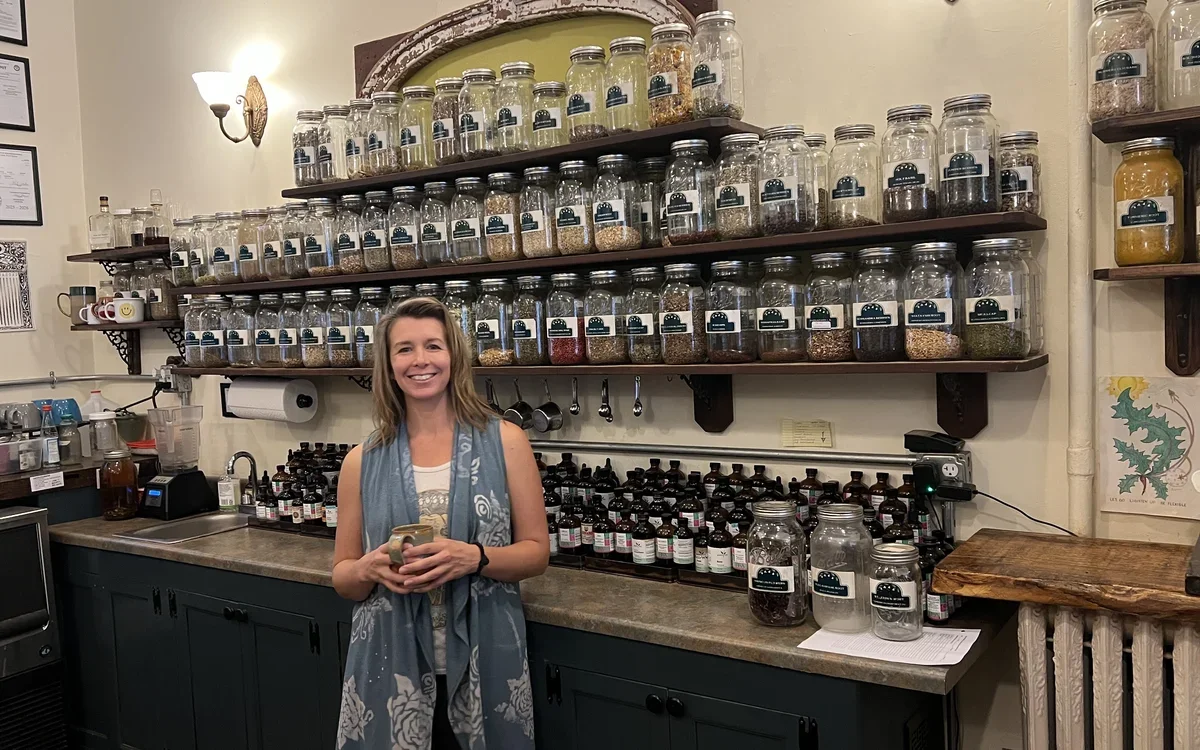
Ashley Davis ’09 is a passionate herbalist and wellness practitioner based in Shepherdstown, West Virginia.
Her journey into herbalism was sparked by her commitment to social and environmental justice. With a background in anthropology and visual art from Bennington College, she discovered a deep connection between gardening, medicine-making, art, wellness, and spirituality. After completing a clinical training program in herbal medicine and a certification in Ayurveda, Ashley began working with clients, teaching workshops, and creating herbal products from her home. Today, through her business, Tonic Herb Shop, she continues to serve her community, formulate products, and offer guidance that connects human wellness with the health of the planet.
Your work blends herbalism, sustainability, and spirituality. How did your journey to herbalism begin, and how has it evolved over the years?
My interest in herbalism actually began while I was at Bennington. One of my dear friends, Jessica Green ’09, had been working with an herbalist in Maine and shared a little bit about what she learned with me. Raspberry and goldenrod, I remember, were the plants she described the properties of, and I was intrigued by how many uses a single plant could have. I was also interested in sustainability and the “think global, act local” movement. I was already working at a nearby organic vegetable farm to learn how to grow my own food, so learning how to grow and make my own medicine seemed like a logical next step.
I took my first Introduction to Herbalism class while I was enrolled at Bennington. It was a six-month weekend program in the Catskills, and I drove two hours once a month to go to class between my junior and senior year. So, I began the journey with a desire to know how to take care of myself and my family without relying on pharmaceuticals. I loved the study so much that I kept taking classes and decided to try to make a living as an herbalist: teaching workshops in my backyard and selling products that I made at local farmers markets. That has evolved into owning an herb shop and apothecary and running a school that teaches clinical herbalism. I no longer grow my own herbs because I don’t have the time or space, although I would love to get back to the gardens. I spend way too much time on a computer these days, doing marketing, updating websites, creating curriculum, ordering products, answering emails, and administrative tasks rather than the fun stuff like growing herbs, making products, and talking to customers.
You studied anthropology and visual art at Bennington College. How did your time at Bennington shape your approach to herbalism and the way you connect art and healing?
While I was at Bennington, I was seeking ways to effectively create social change, both through art and through sustainable development. My studies in anthropology helped me to understand the cultural constructs upon which our Western approach to disease and wellness is built. This allowed me to see the biomedical model as simply that, a model, a framework of understanding based on a materialist and reductionist worldview. Different cultural approaches to healing became equally valid, and equally subjective. My senior thesis, “The Cultural Constructs of Illness and Wellness,” was essentially a way of giving myself permission to diverge from the mainstream ideals that I was brought up with to pursue other traditions of healing. I appreciate my training in anthropology, as it continues to help me stay aware of my biases and keep the traditions that I have learned about within the context of their cultural framework. As someone who shares wisdom from other traditions, I do try to convey how these philosophies were developed in cultures with different climates, so their seasonal correspondences don’t perfectly align with ours in the United States. Sometimes my background in anthropology is a hinderance because I worry about things like cultural appropriation, but I’ve gotten over the reluctance to burn sage or palo santo as a smudge because every culture has some form of incense of plants that they burn to help clear space. The plants vary by region, but the spiritual underpinnings are not dissimilar, and I feel that we all have a right to smudge, as long as the plants that we are using are ethically harvested.
Visual art will always be a passion of mine as well. Not "art with a capital A" necessarily, but the art of finding beauty in the mundane and trusting in the creative process will always be important to me. I always consider aesthetics in the things that I create. I like to add an herb for color and beauty to every tea blend. I designed the store with beauty in mind, painting a mural on our wall, making the stained glass valences over our windows, and refinishing old wooden arches to make our menu boards. Between running two businesses and mothering two children, I don’t have much time to make art these days, but I do still have a creative outlet in the custom herbal formulas that we make for the clients that we see in our clinic. This is both an art and a science.
My approach is to first engage the left brain, to consider which organs, systems, and actions to focus on. I come up with a formula and then step back and look at it like a painting (literally, I write it out on the whiteboard, take a step back, and try to take in the whole rather than the parts). Then I make adjustments until it feels right. My students often ask me how I know when a formula is done, and I say “it’s the same as how you know you are finished with a painting or a sculpture; you keep working on it until you feel that sense of harmony and satisfaction.”
After completing extensive training in herbal medicine and Ayurveda, what have been some of the most rewarding aspects of working with your clients and creating products for your community?
The most rewarding aspects are definitely getting positive feedback when the herbs work. They usually do, as long as one uses them consistently. Consistency is key with herbs. Sometimes we get customers stopping in or emailing us to say how well the tea worked for their joint pain or how well the salve worked for their eczema. And we have had a few miracle stories from clients who have been freed from chronic fatigue, from miserable periods, or who were able to conceive after a few months of a custom herbal protocol. Those are always the biggest paybacks from this work. One client with Cushing’s syndrome was so thrilled to see her cortisol numbers drop from 300 to 150 in a month that she gifted the Sacred Garden School enough money to create a scholarship fund.
Another reward is from witnessing the lightbulbs that go off in the minds of students when they begin to innerstand (not a typo) the elegance of how plants work, how they interact with the body, how the seasons correspond to the elements and the organs. I love teaching people about the usefulness of invasive species and changing the way people view invasive plants and weeds. I love empowering people to make their own medicine with abundantly available plants and how weeds can be superfoods. This past year, I have been teaching monthly workshops at my children’s school. In March, we made chickweed pesto and tasted chickweed tea, and I was pleasantly surprised at how many of them loved it! In April, we tasted violet tea and made a violet soda with seltzer water and violet flower syrup. I had two mothers call me that following weekend to say that their kids were picking violets from their backyards and asking to make tea and soda with them. The kids have been super excited to learn how to use the weeds in their yard, and their parents have been grateful for them having an opportunity to learn about this at a young age. That’s been a huge reward for me this year.
You’ve mentioned being fascinated by the connection between human and planetary wellness. How does this philosophy influence the way you approach your practice at Tonic Herb Shop?
I think anyone who studies herbalism understands this connection at some level, but I was blessed to have that be a focal point in my herbal education. How can we have clean lymphatic fluid when our oceans are polluted? Our bodies are roughly 70% water. Our Earth’s surface is about 70% water. We are a microcosm of the macrocosm. How can we have strong gut integrity when we have soil poisoned with glyphosate? The earth element is responsible for creating boundaries. Glyphosate, a broad spectrum biocide, kills the beneficial bacteria in our gut and contributes to leaky gut syndrome, aka increased intestinal permeability. Poisoned soils lead to poor boundaries in our intestines, whose job it is to selectively allow nutrients in and keep everything else out of the bloodstream. This is a huge underlying cause of many conditions, including autoimmune conditions. The world is inflamed, so we are inflamed. Or maybe it’s the other way around. But gut healing herbs will only get us so far if we continue to compromise our gut health with chronic exposure to antibiotics, NSAIDS, pesticides, chlorinated water, and overconsuming processed foods.
You emphasize the importance of reconnecting with the seasons for healing. How do you incorporate this idea into your workshops and the products you create for people?
My first-year curriculum is structured around the seasons and the corresponding elements. We follow Chinese five element theory and start with the wood element in the spring, which corresponds to the liver, and we talk about the reasons that this is an ideal time of year for a detox. We then cover the fire element in June around summer solstice and discuss the cardiovascular system this month. In late summer, earth and the corresponding stomach/pancreas, which are all about nutrition. We also use the Ayurvedic framework of the doshas and discuss how to balance kapha in the spring, how to balance pitta in the summer, and how to balance vata in the autumn. People love to hear that they have permission to eat mashed potatoes and pumpkin pie in the fall. These nutrient-dense, grounding and rich foods are appropriate for this time of year.
As the outside world is getting colder, lighter, less dense, we get prone to dryness, anxiety, deficiencies, spaciness, and irregularities. These heavy foods balance the dominant energy of the season to keep us from feeling too airy and dried out. In the store, I choose seasonally appropriate herbs to highlight as our herb of the week and herb of the month, and feature products that are seasonally relevant. Most of us intuitively feel called to eat cooling foods in the summer, like watermelon, cucumber, lettuce, and blueberries. We can also use cooling herbs like linden, oats, hibiscus, rose, lavender, hops, passionflower, and motherwort to support our inner terrain in combating oxidative stress and supporting our cardiovascular systems. We promote our cooling teas as well as our first aid remedies in the summer. In the winter, we may educate people about herbs that can help with sleep and counter viral infections. Something that we may do in the future is offer seasonal boxes, like an herbal CSA with seasonally appropriate remedies and a newsletter that explains the dominant elements of the season and the herbs that can keep that in balance.
When working with clients one-on-one, we also consider the dominant energetics of the person. If there is an imbalance, you may need to do more than simply eat and consume teas that are seasonally appropriate. We may adjust formulas to be more cooling in the summer and more warming in the winter, but we’re focusing on the energetic imbalance that we see, and the season is secondary consideration. But as preventative medicine, to help maintain balance, I do believe that eating/drinking/using seasonally appropriate herbs is important, easy, and intuitive once you learn the concepts and language. It is a fundamental part of all vitalist traditions of medicine, including traditional Chinese Medicine, Ayurvedic Medicine, Greek, and Unani-Tibb. These systems are rooted in keeping the vital life force energy (qi, prana, physis) flowing smoothly. Seasonal balance keeps us and our vital energy in flow and less likely to be thrown out of balance in a severe way.