Moving Image in the Archive
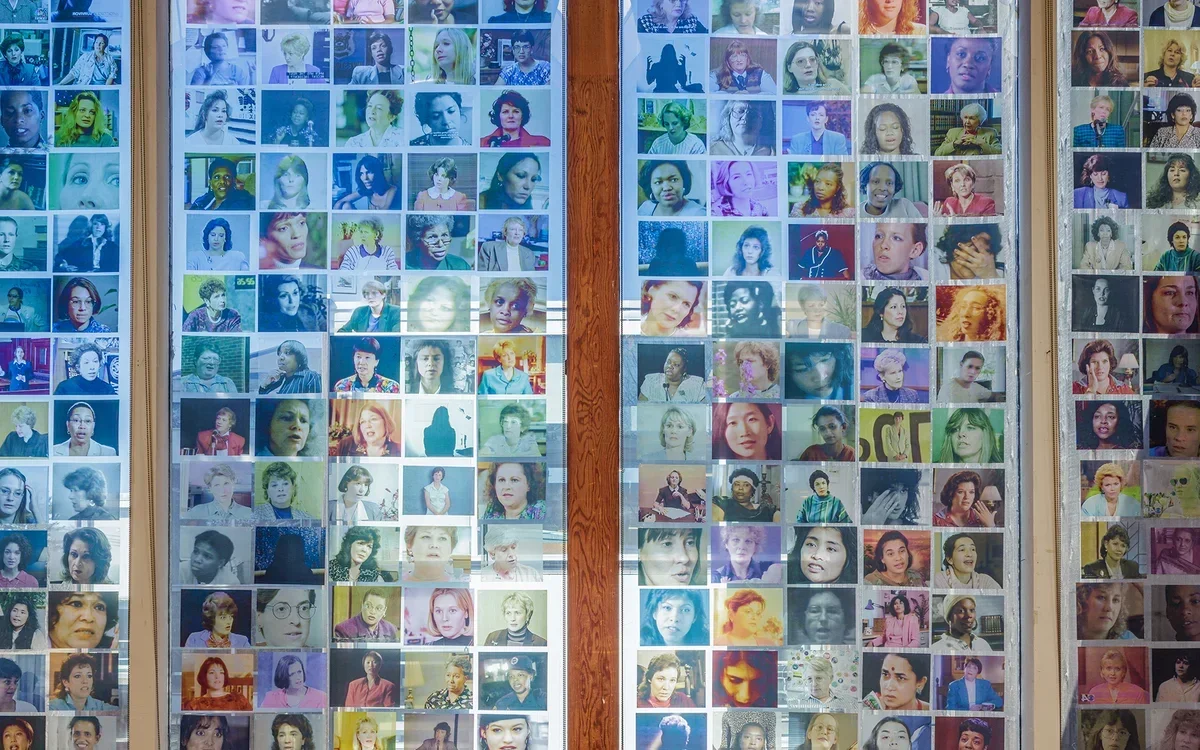
A conversation between artist Carmen Winant and curator Anne Thompson about Double Jeopardy, an exhibition at Usdan Gallery of Bennington College.
AT: Let’s start with the exhibition title, Double Jeopardy. What does it mean?
CW: “Double jeopardy” is a term used by feminists, particularly in anti-violence work, to signify twin threats. I heard it often in videos referring to the precarity of class and gender, but it can also refer to gender and race, especially Blackness. In other words, if you’re poor and a woman, or a woman of color, you are in this state of double precarity.
There’s triple jeopardy, too—racism, sexism, and classism, or imperialism, militarism, and patriarchy. It’s a somewhat outmoded term. Today, we’d use the language of intersectionality to describe how our myriad identities are crisscrossed and simultaneous, that one mode of identity doesn’t take precedence over another.
AT: This exhibition presents your first works in video. This might be a leap, but I wonder if you, as an artist, felt another kind of jeopardy—in the sense of risk or challenge—in navigating a video project. What were the stakes for you here compared with previous projects?
CM: That is the question in some ways. I mean, I’m still working through it.
Moving image is intimidating for me. I’ve always been attracted to being able to rearrange the narrative, to plug cells in and out. That’s something you can’t do in the same way with film or video. I mean, it’s possible, but editing in that way becomes a really conscious and visible choice, like, French New Wave or something, where rearranging becomes the subject.
I’ve never wanted to be a collage artist who makes her cut the subject. I want the stories, I want the history, I want the women to be at the surface. I don’t want my method to be a point of—I shouldn’t say distraction, but I don’t want it to be the subject.
That was something for me to wrestle with.
Moving image can also be more intimate. You hear people drawing air, you know? You hear the inflection, you hear their voices crack. You can see tears start to well up in their eyes and them holding back the sob. That’s not something you get from a still image. I had to think about my responsibility as an artist, as a person, in working with that kind of material. On an emotional level it felt different than dealing with stills.
I think that without realizing it, both of these reasons held me back for a long time from working with moving image as a medium. Because I’ve had opportunities in the past, and I always found a way to circumnavigate it.
AT: Speaking of narrative, video, even a video fragment, can contain an unavoidable linearity. And decentralizing the narrative, as well as interrogating traditional or default narratives, is central to your practice. How did linear narrative play out in making Double Jeopardy? Do your videos contain story?
CW: Yes, but it’s not like watching a narrative film. There is something more circular about it. Most of the material I selected is of small groups; they take turns listening and talking, and their stories resemble one another’s. They circle back, they work to process and support each other in feelings-based conversations. In this way, there is no linearity to the story, no plot. So, in some regard, I wasn’t as uptight as I thought I would be about things having a determined sequence.
AT: That’s interesting, because there’s an element of circularity present in your work. Most—or maybe even all—of your still-image collages contain formal repetition: photographs of the same events occurring to different people in different locations or time periods, or images of similar interiors, landscapes, and objects across time and place, like, maybe not exactly this, but a sunset from 1975 next a sunset from 1995. How did you bring these formal ideas—or this aesthetic—to video when contending with audio alongside visuals?
CW: There’s quality that can exist, as you suggest, in stills, audio, or video which is not quite repetition but more like reiteration. Small movements seem to closely resemble each other. Maybe they’re in sequence. Or maybe they’re spread around, so that there’s a kind of larger visual echo. My hope is that the reiteration points to labor and the decentralization of labor, that these groups are happening everywhere and that the work is quiet and unremarkable. I’ve done a fair amount of organizing, most recently in the context of my own university. So much of organizing is administrative. Someone has to take notes, maintain the spreadsheet, update the members. It’s how shit gets done. Movements are made this way. I’m thinking about those strategies in my artwork.
AT: One of your approaches is to tackle politicized uses of photographic images or practices by flipping them around or back on themselves to present a different side of the story or to complicate the narrative. This is especially clear in The Last Safe Abortion, your work in the 2024 Whitney Biennial, which features hundreds of snapshot-size photos of the quotidian workings of abortion clinics. It counters the way photography has been weaponized by the anti-abortion movement. Photography isn’t a usual tool of the pro-choice movement, but—as a medium—it’s enmeshed in the ideologies and strategies of the other side.
With Double Jeopardy, you’ve made artworks in video—a new medium for you—about a time period when video was a new medium in the culture. You seem to be working again in a meta way, using a medium to critique its forms and uses. I’m curious about your thinking about video as a historical medium and its role in the anti-violence movement. What was its function?
CW: I don’t want to collapse the abortion project and Double Jeopardy. But it is true that they have a lot in common. They are both projects about feminist public health, and they both consider the ways in which their subjects—be it abortion or domestic violence—are mediated in our larger cultural imaginations. They tend to be projected as sensationalized, highly agitated images. There is so little emphasis placed on the daily, lived realities of the women seeking care and of those who support them.
Part of what drew me to working with the National Coalition Against Domestic Violence (NCADV)—not dissimilar from the abortion work—is that I wanted to access the material of people doing this work from the inside. Anti-violence work in this country in the early and mid-1970s came out of the women’s liberation movement. Activists began to organize, contending with local, state, and national governments to create safe spaces for women, be they shelters or broader advocacy networks.
And if you’re on the inside, how does that actually work? Who are you serving? What do they need? How do you train? It’s not a surprise in that framework to imagine audiovisual material in service of victims. For example, survivors need workshops toward financial independence. It may seem boring, but many videos offer just that: information about how to do a job interview or how to file your taxes. And then there are lots of videos, many of them staged, about how to facilitate group conversations or therapy. NCADV made their own videos but also received lots of video from other domestic-violence organizations, insurance companies, and corporations.
NCADV videos also take stock of the larger cultural moment they are in. They recorded television news programs, for instance, about the murder of Nicole Brown Simpson—and then sometimes they appear as representatives of the movement on those same shows. They taped television programs in which domestic violence is discussed, be it on PBS roundtables or the Phil Donahue Show. They even recorded movies, plays, and music videos in which this experience is represented. The archive is more than one thing. It is something they were always growing, making their own history.
Rita Smith, the former director of the NCADV, is largely responsible for this archive. She saved this material for 30 years. And we are just talking about the video tapes, to say nothing of documents and everything else in the archive.
AT: At times this archive feels like a time capsule of video as new technology, its flexibility and its power. It exists on all levels of production, audience, and intention—amateur, government, corporate, news, entertainment. And then it cycles back on itself, as a kind of precursor to what happens now with smartphones and social media. I’m struck by the idea of women in the movement making DIY educational videos, then going on TV to talk about the movement, and then video recording their TV appearances.
CW: Totally. The other thing I wanted to say in response to your question about the role of video is about reenactment.
There might be a 40-minute video, let’s say, of men talking to other men. They would have called it a “former batterer’s” group. Our closest proxy would be group therapy. And it’s all being acted—or rather, re-enacted. It can get sort of fuzzy, because many of the tapes are not labeled. But oftentimes it is clear that the men in the videos are not only staging these scenes for the benefit of the camera, but that they are former abusers who have already gone through this process.
The majority of groups depicted in the videos are women’s groups. And it’s important to note that usually group videos of this kind are reenacted largely by people—men or women—who were themselves exposed to, and actively benefited from, this kind of group healing. I find it really profound and moving. What an act of generosity and of bravery.
AT: Our decision to construct a wooden house inside Usdan Gallery as the exhibition anchor obviously points to the “domestic” element of the Double Jeopardy content. The violence being discussed is happening in the home. And the era of early video also resonates with the “domestic” in the way video allowed people to produce and consume content at home and on their own terms.
It seems wild given technology today, but in the time period you’re dealing with it was a completely new thing to be able to record TV programs to watch later or rent movies to watch in your living room. The medium creates new kinds of home activities; it allows for intimacy and privacy. Yet here it also becomes a tool for documenting stories of abuse happening in those same intimate and private spaces—taking it out of the house and into public or community spaces for education and healing.
CW: It’s true that video changes our understanding of, our access to, what home life is like and how it can be recorded. The technology was becoming widely available in the 1970s at the same moment anti-violence work was emerging. The fact that this larger cultural shift in our consciousness coincided with the technological accessibility is not incidental; I am really glad you bring that up.
AT: What surprised you most about the different types of videos that NCADV workers were making for their own purposes?
CW: I've been particularly interested in the training videos—these videos that exist somewhere between training and documentary, staged, or reenacted. It just feels like such an important, in between genre.
And there are a number of other videos, too, that stage reenactments of violence. As part of anti-violence work, they would reenact and make videos of domestic violence inside the home. I didn’t include any of these videos in the show, because the show is not centered on images of violence.
Because my sense is that women who have been through that do not need to see reenactment. They don't need to see the violence. They've already lived it.
AT: This is your second exhibition of work that draws from the NCADV archive, after A Brand New End, at The Print Center in Philadelphia in 2022, which also drew from the Philadelphia archive Women in Transition. How did that show lead to the making of Double Jeopardy?
CW: A Brand New End drew from the organizational archive in Philly more heavily, in large part because the show was there and also because they had had a volunteer archivist come in a year or two before me, coincidentally, who got everything hyper-organized. It was just easier to access.
When I first went into the NCADV storage unit, in Denver, I found about 110 boxes, piled 10 high and over 10 deep. It was a more intimidating prospect, and one that demanded more time. For the Philly project, I was looking for photographs and newspaper clippings exclusively. But I kept encountering VHS tapes. I couldn’t help but notice that there were hundreds of them. There were also some Super 8 films and another kind of magnetized film I’d never seen before. And I remember staring at them and thinking, what is on you? Based on everything else I was encountering, I knew it would be substantial.
Another thing is that this research could feel, at times, emotionally harrowing. Doing it in stages allowed me to move slower and be more careful with myself. When the time came back around to continue, I thought at the very least I would digitize the VHS tapes, which can start to de-magnetize after 30 or 35 years. The question of making a new project felt interrelated but sort of secondary. And now they are digitized for the historical record, so thank goodness for that.
AT: And clearly having the video content shifted your work in new directions in terms of content and tone.
CW: A Brand New End was about the work of activists and staff inside the anti-violence movement. It really focused on their solidarity, their socializing with each other, their social networking, and the techniques they used in the office.
And across all my projects the through line is: How do feminists get organized? What does it actually look like? What does it take in the conventional sense of political organizing but also interpersonally? How do we relate to each other? And that carries through. But I think it's undeniable, and you've been pulling out this thread, that the videos do something different. They center the survivors and their pain, their incarceration in some cases, and their pathways to healing as well as their setbacks.
I want to take care to acknowledge the real overlap between the staff and the survivors. But I do think that this project is much more survivor-centric. They’re the subjects, especially in how they talk about their experience, because so many of them are still inside it. It’s not as sunny as the other show.
And also, there is this component of engaging in the broader discourse that didn’t exist in the first show. I’m thinking of the Double Jeopardy (Women to Camera) video stills of women speaking in public, on the Today Show or Nightline or on a program made by an insurance company or a corporation. These tapes are much more outward facing. So the question becomes not only how do survivors share themselves with each other but also how do they represent that knowledge to the public? That’s something captured over and over in the archive that I wanted to make some sense of in the exhibition.
These are not conscious decisions for me at the outset. I wade through the material and see what happens. To paraphrase Edward Said on this, all I can do is appeal to the past. It doesn’t owe me anything. But if I am lucky—if I remain nimble and responsive—it speaks back.
AT: I’m thinking again of the element of repetition—or, as you said, reiteration—in your work which here mirrors the repetitive nature of therapy and recovery. An enormous part of that process is to tell your story again and again and, with programs like Alcoholics Anonymous, to do so in front of an audience. The hundreds of portraits in the Women to Camera piece address that condition of being an individual who out of necessity is also part of a larger collective process. And at the same time, you have the audio repetition from the videos of people in groups, which is a different kind of collective process.
CW: My hope is they’re hitched to each other. I mean the video and still-image components are different but they both point to the exact thing that you’re saying about solidarity, visibility, and an operational network of people. It sounds so obvious, but the discarding of shame, which can be an ongoing process, is made possible by the precise experience of not feeling alone.
AT: You’ve talked in the past about whiteness within aspects of the feminist movement. There’s this dominance of white women despite gestures toward or desires for intersectionality. What do you think about race and whiteness around this particular content?
CW: That’s such a good question. This question first surfaced for me in a major way in 2018 when I was working on My Birth. I really wrestled with that project while making it. Because I was like, oof, there’s so many white ladies and it’s almost all hetero couples and almost all vaginal births. I felt like, on the one hand, isn’t this amazing? isn’t this feminist? isn’t this radical? And also, on the other, isn’t this normative? isn’t this, you know, white supremacist?
I ended up contending with this quandary by writing about my struggle to find representations of queer, Black, and surgical births in the wall text. I talk about it in the one-minute I was given for the audio guide, and I bring it up every time I am interviewed about that work. But that is a pretty imperfect solution, and in some ways, it’s one that still haunts me.
As I started to look toward other projects—I don’t even know how much I did this consciously—I just gravitated toward spaces that had contended with questions of race among their ranks. If I was going to center and hold up certain histories, then I was going to do that where there had already been a kind of reckoning.
That was the case, certainly, when looking at abortion work, which I found to be a much more multiracial space, and also an intergenerational space, than I had imagined. I don’t mean to glaze over parts of that history that have been racist and exclusionary, but I can say that much of the local histories I encountered in my research were heavily integrated.
That’s all to say that it was fascinating when I arrived at the twentieth-century history of anti-violence work, which is not especially visible when we think about the feminist movement and its gains. Anti-violence work, maybe because it’s not as marketable, is not at the center. It’s sort of at the fringes of that larger historical telling, if and where it appears at all.
But, as I arrived here, I was just like, wow, holy shit, this history is the most diverse—speaking mostly of women across races but also disabled women, older women, trans women, and cutting across social class. You could just see it in the pictures, in terms of who is working at these places or attending their offerings. So many of the organizations were led by Black and Brown and Asian women, led by lesbians. I am not saying that there weren't struggles. I am just saying that they were so far out ahead of the rest of us.
AT: While Double Jeopardy presents your first moving-image artworks, this is not your first time working with moving-image content. For My Mother and Eye (2025), you used still images from a Super 8 film your mother made during a cross-country road trip in 1969. Separately, in a recorded interview about that project, your mother describes her optimism. She recollects feeling grateful to be living in a revolutionary moment, that, as a young woman exploring the United States in 1969, she had a feeling of expansiveness and freedom, that the civil rights movement was giving way to the feminist movement and that things were only going to get better and fairer. I almost started to cry. The difference between that sentiment and how someone might feel now about our country is really stark.
CW: I think about that moment, too.
AT: How you think Double Jeopardy lands or should be situated in consideration of social and political conditions today?
CW: What a different world I am living in from my boomer parents, who really believed that the world would only continue getting better. Our time can feel pessimistic, even doomed. But there are glimmers. There have to be. Consider the organizers doing mutual aid and political organizing and training in Minnesota as we speak. You have to believe a different world is possible to do that work. Optimism is a tool of political necessity.
That’s kind of the blood running through the veins of my practice—or I hope it is. It turns out that a project “about” domestic violence is ultimately a project about feminist solidarity. On some level, I hope the work operates as instructions on what it takes and looks like to heal through organized efforts that are predicated on being common with each other.
AT: Despite its heavy content—or maybe in conjunction with the heaviness—Double Jeopardy does contain optimism, as does the NCADV archive. There wouldn’t be an archive without hope, that grit and desire to get yourself out of one situation and into another one, and then to want to help other people.
CW: Yes, that’s got to be it.