
Sustainability at Bennington
At Bennington College, we strive to foster a community that not only cares about global problems, but does something about them. Both in the classroom, and in our daily lives, we make sure that environmental, economic, and social issues are considered in our designs, our questions, and our work.
We don’t assume that sustainability is achieved through the most conventional path, but instead seek to engage continuously with our evolving world, through active questioning and investigation. Just like our educational mission, our sustainability initiatives seek to push boundaries, to link together disciplines and perspectives that are otherwise separated. Perhaps most importantly, we learn through practice, by taking our ideas and applying them to the real world.
Renewable energy
Bennington College’s biomass heating plant saves fossil fuels by using renewable biomass, a byproduct of the lumber industry. In addition, Bennington’s Center for the Advancement of Public Action is a geothermal building.
Purple Carrot Farm
Purple Carrot Farm is a 1.2-acre no-till regenerative farm dedicated to soil health, biodiversity, building community, and creative experimentation. Produce from the campus’s farm, Purple Carrot Farm, is served in the Dining Hall. This effort reduces food miles to food steps and saves on packaging waste. Plus, the campus chefs love using the farm’s produce, and the campus community loves eating it! It could not be fresher! A small student-planted food forest was added to the farm in 2025.
Habitat
Grasslands are a threatened habitat, and grassland birds are among the most rapidly declining species in the U.S. Bennington hosts nesting bobolinks and eastern meadowlarks each spring, both of which are classified as near threatened by the IUCN and locally endangered or extirpated in many parts of the eastern U.S. Bennington students are also currently leading plans to earn Bennington College’s designation as the state’s very first arboretum.



Research
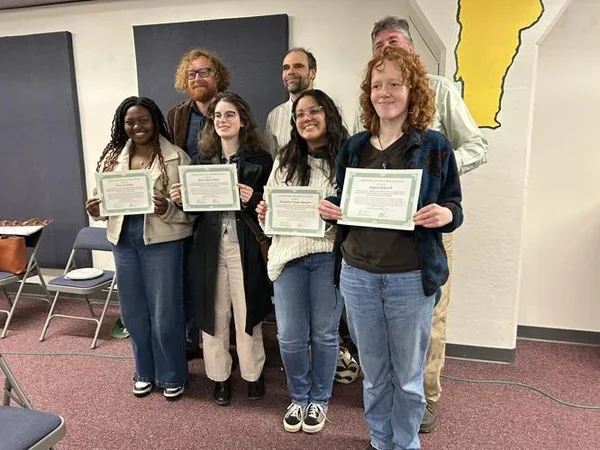
Bennington students have been integral in continuing research into PFAS contamination of the local water supply. Their work has been used to hold polluters accountable. In addition, Bennington participates in MOTUS—an international research community working together to study the movement and behaviour of birds, bats, and insects. An automated telemetry antenna for the project sits on top of the Dickinson Science Building.
Advocacy
Beyond Plastics is an international project based at Bennington College with the mission to end plastics pollution everywhere. Students work with Beyond Plastics staff and with environmental groups across the country and around the world through the Endeavor Environmental Action Fellowship.
Waste
The campus cafe, Roz's, is a low-waste cafe. A mug share prevents people from needing to use single-use cups, and it is just more fun! The Dining Hall also monitors food waste and conducts food waste education. Food waste that would have gone into a landfill is composted to create quality soil.
Student Action
The Bennington student body is dedicated in maintaining momentum to keep sustainability a part of the campus consciousness. In many cases, students have been at the forefront of initiatives regarding energy efficiency, local food resiliency, and community engagement. As with all things as Bennington, students shape the way Bennington works, especially towards issues of sustainability.